Luna Abyss Review: I Went Looking for a Sci-Fi Shooter and Found a Moon Prison that causes Anxiety
Falling Into the Abyss
I went into Luna Abyss thinking I was getting a sci-fi shooter.
You know the drill. Strange planet. Weird gun. Maybe a robot voice telling me I am special while I shoot at things with too many legs. Gaming has trained me to understand that if there is a moon, a prison, and a mysterious abyss involved, someone is about to make their terrible life choices my problem.
And yes, Luna Abyss absolutely does that.
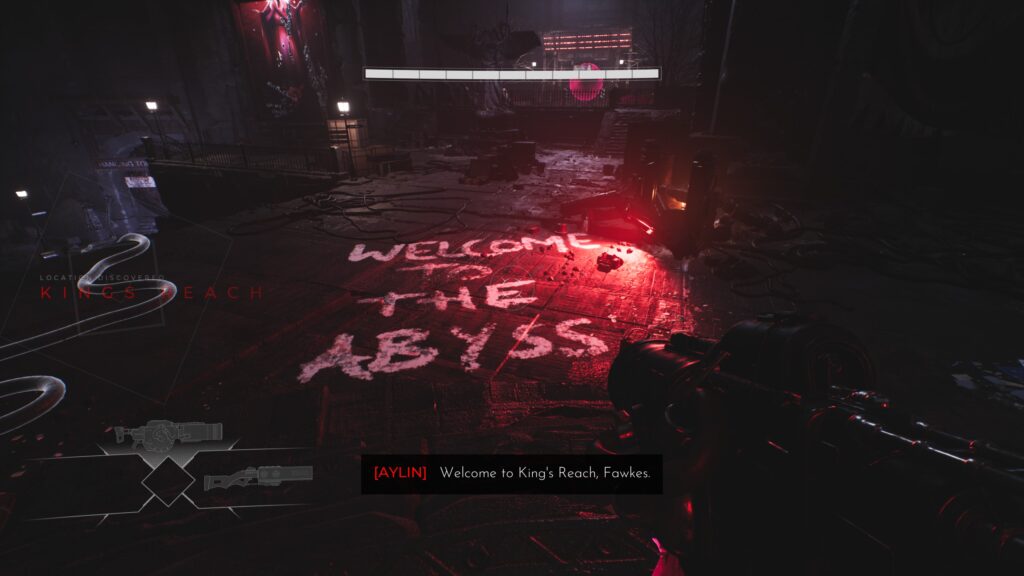
But what surprised me is how quickly it stops feeling like “here is another indie shooter with spooky hallways” and starts feeling like I wandered into a place that was built before anyone invented comfort. Everything is sharp, cold, massive, and deeply unfriendly. The world does not feel like it was made for humans. It feels like it was made to remind humans they are small, soft, and extremely easy to delete.
Which, rude.
But also very effective.
This is one of those games where the environment is doing a lot of the heavy lifting before the combat even gets warmed up. I found myself staring at walls, not because I was lost, although that did happen because I have the directional instincts of a Roomba in a haunted cathedral, but because everything has this strange brutalist beauty to it. It is bleak, but not boring. Industrial, but not generic. Sci-fi, but not “blue hologram number 47” sci-fi.
More like “what if a moon had a basement and the basement was mad at you?”
That is Luna Abyss.
The World Feels Like It Hates Furniture
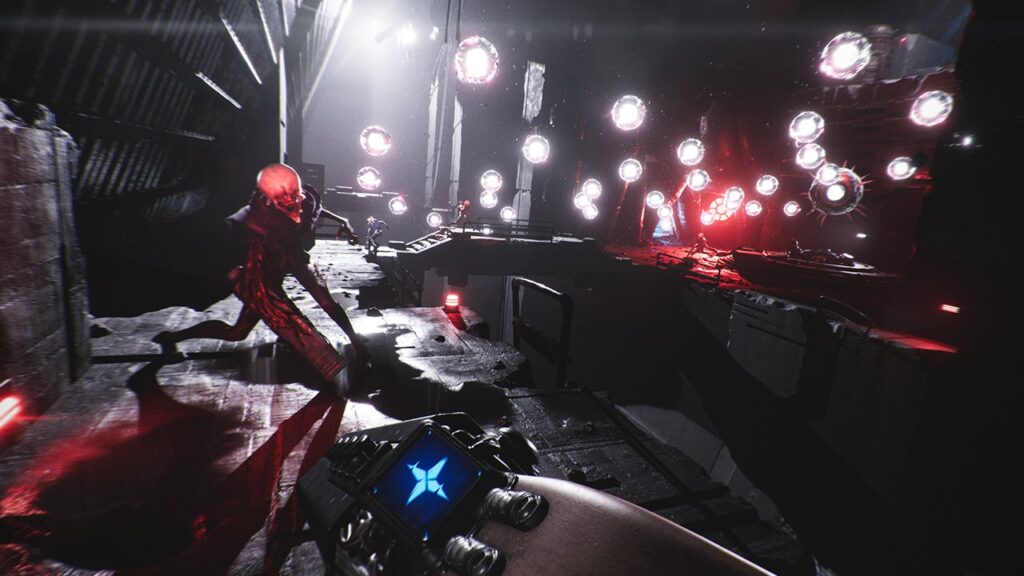
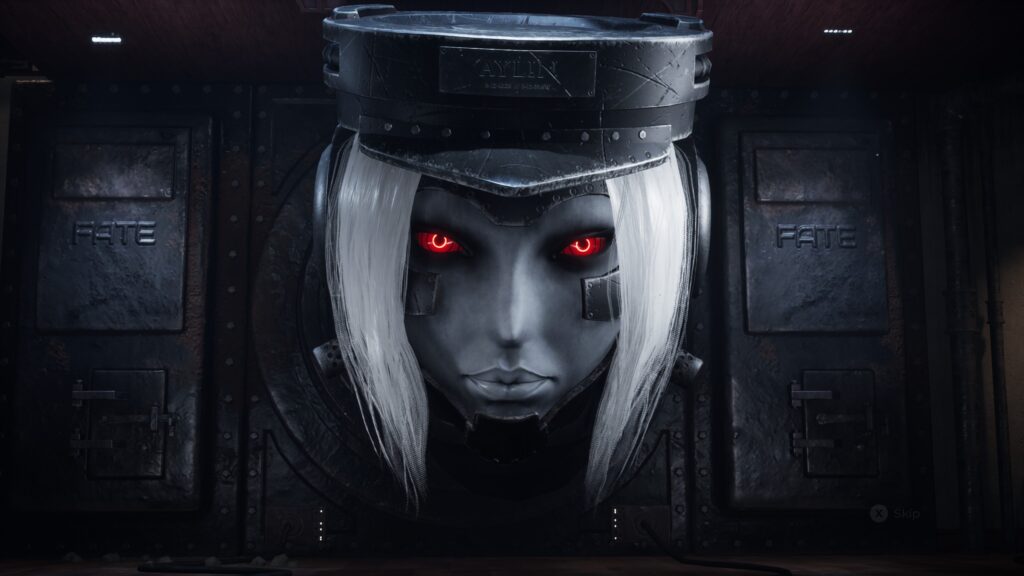
The best part of Luna Abyss right away is the vibe. I know “vibe” is a dangerously lazy word, but sometimes the vibe walks into the room wearing a giant scary moon helmet and demands to be acknowledged.
This game has atmosphere for days. The kind of atmosphere where you feel like every hallway was designed by an architect who had one chair as a child and it was taken away from them. Everything is enormous, empty, severe, and bizarrely elegant. It is not cozy. It is not welcoming. It is not the kind of place where you expect to find a vending machine unless the vending machine sells dread and lukewarm punishment.
And because I am me, I love that.
There is something really satisfying about a game that commits to being weird instead of sanding itself down into “marketable sci-fi.” Luna Abyss does not feel like it is begging me to understand everything immediately. It gives me the prison, the moon, the abyss, the voice in my ear, the strange machines, the unsettling enemies, and then basically says, “Figure it out, prisoner.”
Fine. Great. Perfect. I guess I live here now.
The world is not just background wallpaper either. It creates the tension. Even when nothing is actively attacking me, I still feel like something is wrong. That is the good stuff. That is the part a lot of games forget. Horror-adjacent sci-fi does not always need to throw monsters at your face every fourteen seconds. Sometimes it just needs to make you feel like the hallway has opinions.
Luna Abyss has very opinionated hallways.
Movement Is Where It Starts Clicking
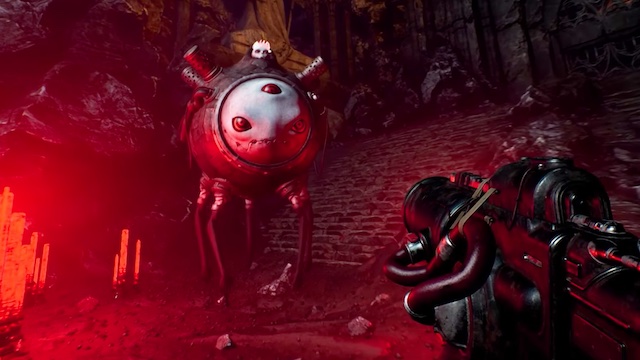
At first, I was taking everything in slowly, trying to understand what the game wanted from me. Then the movement started opening up, and the whole thing became much more interesting.
The platforming is not just “jump over this gap because video games need gaps.” It has an actual rhythm to it. You move through the world with this growing sense that the game wants you to stay active. Jump, dash, slide, correct yourself in the air, land badly, pretend you meant to do that, and keep going.
There is a real flow when Luna Abyss is working. I started to feel less like I was walking through levels and more like I was threading myself through this giant machine. The best moments happen when movement and combat overlap, when I am dodging projectiles, trying to keep my aim together, swapping weapons, and also making sure I do not elegantly fling myself into death like a sci-fi ballet idiot.
Which I did.
Several times.
I am not proud, but I am honest.
The movement gives the game personality. It keeps the exploration from feeling flat and gives combat a needed layer of panic. It is not enough to stand there and shoot. The game wants you moving. It wants you reading space. It wants you to learn the room before the room teaches you through violence.
And the room is a very committed teacher.
Bullet Hell in First Person Is a Weird Little Brain Fight
The combat in Luna Abyss is where I had the most “oh, this is what you are trying to do” moments.
It is not just a straight FPS. It is not just Doom. It is not just Returnal from a different camera angle. It is trying to take bullet-hell ideas and shove them into first-person movement and shooting, which is either brave or a cry for help. Maybe both.
When it clicks, it feels great. You are watching patterns, dodging through glowing nonsense, swapping weapons for the right enemy state, and trying to stay calm while the entire screen becomes a hostile screensaver. There is a lock-on feeling to some of the combat that helps keep the chaos readable, and the weapon swapping gives fights more texture than “hold mouse button until problem stops moving.”
But this is also where the game can get a little messy.
Bullet hell works because you can usually see your tiny little character and all the terrible things coming for them. In first person, your body is basically a rumor. You have to trust spacing, timing, movement, and the visual language of the attacks. Most of the time, Luna Abyss handles this well enough, but there were moments where I felt like I was dodging vibes more than bullets.
And listen, I dodge vibes daily. I live online. I am trained.
But in a fight, I do want a little more clarity sometimes. Some attacks and boss patterns could be easier to read. The game is at its best when the chaos feels learnable. When it gets muddy, it shifts from “I made a mistake” to “I think the moon just sued me.”
Still, I would much rather play a game that is reaching for something strange and occasionally stumbling than another perfectly polished hallway shooter with the personality of a corporate screensaver.
The Guns Feel Good, But I Wanted More Punch
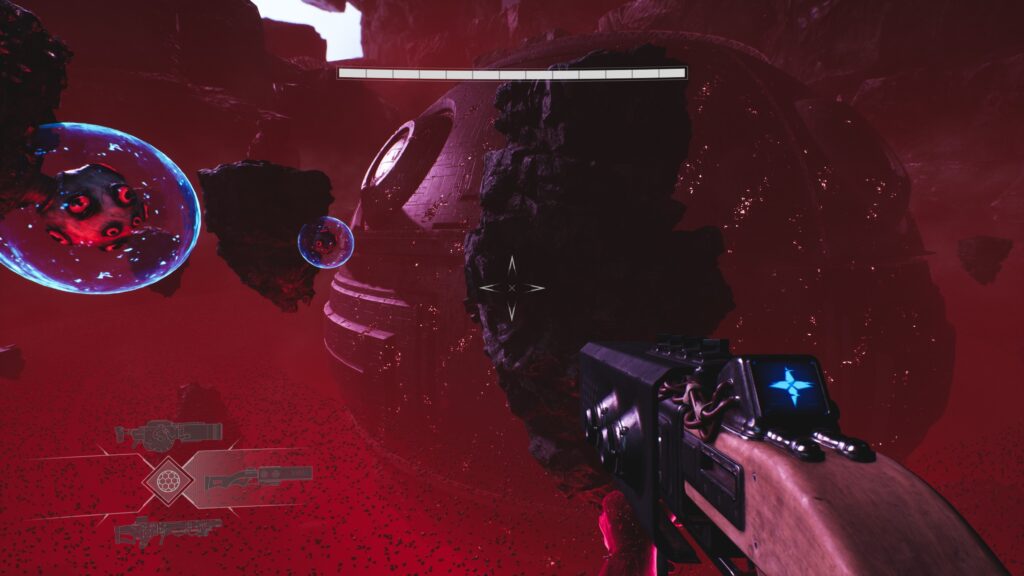
The weapons are functional and the combat flow works, but I did find myself wanting a little more impact from the guns.
Not every gun needs to sound like God slamming a car door, but in a game this atmospheric, weapon feel becomes a big part of the experience. When the world looks this heavy and oppressive, I want the weapons to push back with a little more authority. Some shots felt great mechanically but a bit lighter than I wanted emotionally.
That is a weird sentence, but it is true.
There is a difference between a gun working and a gun making you grin like an idiot because the sound, recoil, enemy reaction, and visual feedback all line up. Luna Abyss gets close, and the combat ideas are strong, but I wanted a little more oomph. More bite. More “yes, I am fighting back against the moon prison,” and less “I am politely submitting a damage request.”
The weapon roles are still interesting. Swapping between tools during fights gives the combat a nice pace, especially when shields and enemy states force you to think instead of turning every encounter into the same shooting gallery. I just wanted the physicality of the guns to match the scale of the world more often.
The Story Is Weird Enough to Keep Me Curious
I do not need every sci-fi game to explain itself immediately. In fact, please do not. I have enough people explaining things to me online with the confidence of a man who just discovered a Wikipedia page.
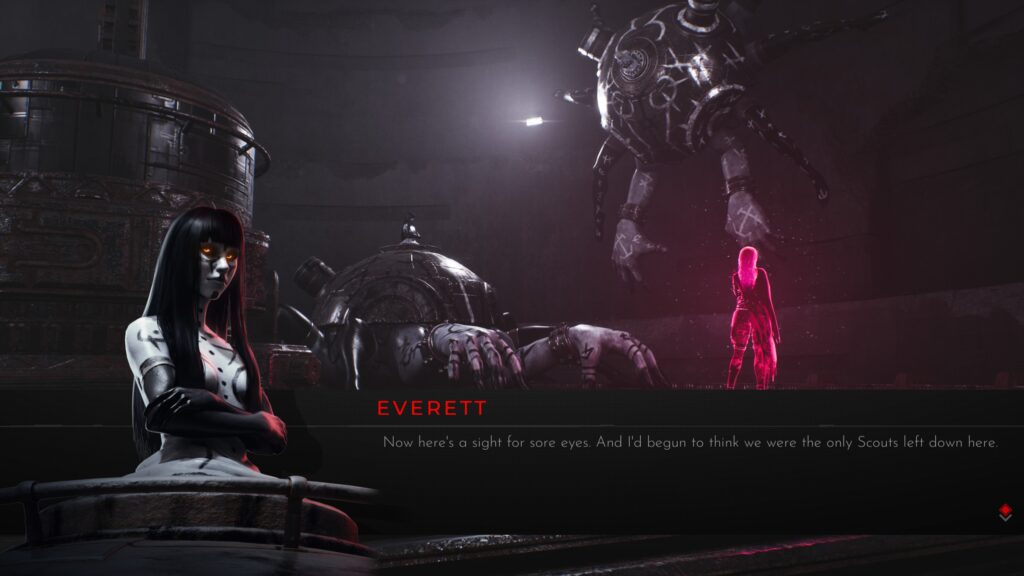
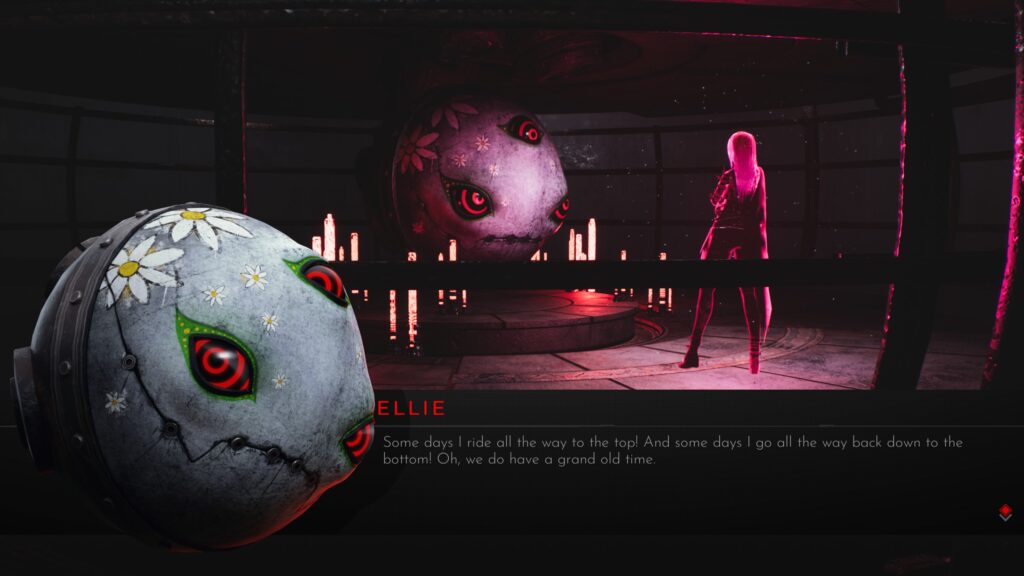
Luna Abyss is more interesting because it lets the mystery breathe. You are Fawkes, you are a prisoner, and you are being sent into a place that obviously has not had a normal day in a very long time. There is an AI presence watching you, guiding you, judging you, or maybe doing all three because apparently no one in sci-fi knows how to make a helper character who is not at least slightly terrifying.
The setup works because it gives you enough to care without dumping a lore encyclopedia on your lap. The world feels like it has history. Bad history. The kind of history that probably has warning labels buried under rubble.
I wanted to keep going because I wanted to know what this place was, what happened here, and why everything felt like a religious structure, prison system, and cosmic mistake all fused together. That is a good hook. Not because the game is shouting “mystery!” at me, but because the environment itself keeps suggesting that I am only seeing the top layer of something much worse.
Which is usually how you know you are having a good time in a video game and a terrible time as the character inside it.
The Audio Does a Lot of Creeping
The sound design helps sell the whole thing. Luna Abyss has that cold, echoing, mechanical emptiness that makes spaces feel bigger than they are. The game understands that silence can be uncomfortable, and that a distant sound in a giant hostile structure can do more than a cheap jump scare.
The voice work also helps give the world personality. I liked having that presence in my ear because it made the prison feel organized, not abandoned. That is creepier to me. An abandoned nightmare is one thing. A managed nightmare is worse. Someone has procedures. Someone has policies. Someone has definitely written a handbook for sending prisoners into the cosmic murder hole.
The music and ambience give the game a larger sense of drama without making it feel like it is constantly begging for emotion. It is moody, eerie, and theatrical when it needs to be.
Basically, it sounds like a place where HR would be an eldritch committee.
The Rough Edges Are Real
As much as I enjoyed Luna Abyss, it is not flawless.
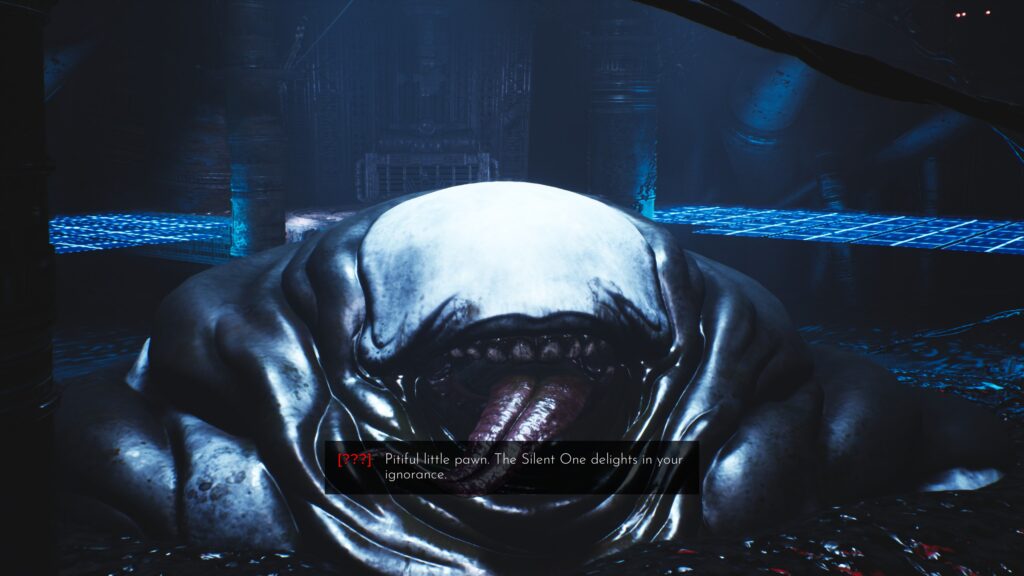
The big one for me is readability. Most of the time, the visual style is a strength. But when combat gets busy, especially with bullet patterns and darker environments, there are moments where I wanted cleaner information. I do not mind dying because I messed up. I do mind dying because my brain is trying to separate enemy fire, environmental detail, UI elements, and my own panic in real time.
The controls also feel like the kind of thing that will matter a lot from player to player. Sensitivity, weapon swapping, FOV comfort, and general input feel are not sexy review topics, but they can make or break a first-person game. Luna Abyss is asking for precision while also asking you to move constantly, so any friction in those settings becomes much louder.
This is the kind of game where small tuning issues do not stay small. If a weapon swap feels awkward, you feel it. If a projectile is hard to read, you feel it. If the FOV is not comfortable for your setup, you feel it. The whole game is built around motion, pressure, and reaction, so the basics need to be tight.
It is not broken. It is not a disaster. It just has spots where the ambition is slightly ahead of the polish.
Pros
The world design is fantastic. Luna Abyss has a strong identity and does not look like every other sci-fi shooter trying to win the Steam algorithm lottery.
The atmosphere is the star. It feels oppressive, strange, lonely, and genuinely interesting to move through.
The movement gives the game energy. Dashing, jumping, sliding, and platforming make exploration and combat feel more active.
The combat concept is genuinely cool. First-person bullet hell is a risky idea, but when it works, it creates a very specific kind of panic-fun.
The story setup made me curious without burying me in lore sludge.
The audio adds a lot. The world sounds empty, huge, and wrong in the best way.
It feels weird on purpose, which I respect deeply because we need more games that are willing to be little freaks.
Cons
Combat readability can get messy, especially when bullet patterns, dark environments, and movement all pile on top of each other.
Some weapons could use more punch. The mechanics are there, but I wanted more impact from the sound and feel.
The control and comfort settings need to feel perfect in a game like this, and some parts may feel awkward depending on your setup.
The game’s strongest ideas also make it more fragile. First-person bullet hell is a cool concept, but it leaves less room for unclear visual information.
If you want a simple shooter where you turn your brain off and delete enemies, this is probably not that. This game wants you awake, moving, and occasionally questioning your spatial awareness.
Final Thoughts

Luna Abyss is the kind of game I appreciate because it is trying to be something specific. Not safe. Not bland. Not another sci-fi shooter wearing someone else’s armor and hoping nobody notices.
It is strange, atmospheric, moody, and occasionally frustrating in the way ambitious games can be. It has moments where I wanted more clarity, more punch, and a little more polish around the edges. But it also has moments where I was fully locked in, moving through this awful beautiful moon prison, dodging glowing death, listening to unsettling voices, and thinking, “Okay, yes, I want to see how much weirder this gets.”
And that is the hook.
Luna Abyss is not perfect, but it has personality. Real personality. The kind that sticks to the walls. The kind that makes you remember a hallway because the hallway felt like it had a backstory and possibly a grudge.
For me, that goes a long way.
If you like atmospheric sci-fi, first-person movement, bullet-hell chaos, and games that feel like they were made by people who had a very specific nightmare and then built architecture around it, Luna Abyss is worth keeping on your radar.
Just do not go in expecting comfort.
The moon is not here to tuck you in.