LiberNovo Wanted “Honesty.” They Signed For it. Then They Called It A Risk.

I would much rather have given constructive criticism on the chair than on the company.
But when a company makes honesty feel unsafe, the company becomes the story.
This is the documented journey of a brand that said it wanted honesty, signed for it, then repeatedly needed to be appeased to do the one thing the contract already promised: let me be honest without payment being used as a pressure valve.
What a company does when the money is on the line, and the truth gets inconvenient, tells you more about the warranty and the support than any marketing render ever will.
Companies work for you.
You do not work for companies.
If you only take one thing from this story, take that.
My experience is the lens, but it is not the whole picture. Once I started pulling on the loose threads around LiberNovo, what unraveled was bigger than one contract and one chair.
Disclaimer
Some people will see a creator calling out a brand and immediately go, “cry more, you get free stuff.” Well congrats, a “million dollar” company duped you to fight your fellow consumer and band against free speech(opinions, honesty, personal experience).
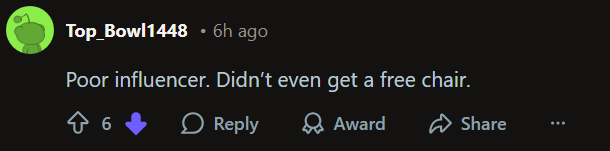
Here’s the part people skip.
- This is my job.
- My time isn’t free.
- This was a substantial paid contract.
- Even when products are comped, creators are supposed to be a first line of defense between consumers and bad products, bad companies, or both.
- You can’t buy every single product your audience asks for. I’m not rich. Most creators aren’t. That’s why review marketing exists.
Here’s the simplest way to understand what happened:
Imagine your boss signs your employment agreement, emails you all week, confirms the agreement is legally effective, and when you walk into your first day ready to work says: “Yeah, we’re not paying you. Good luck.” has security escort you out. Or in this case, stop replying to emails.
That is the core issue. Not ego. Not entitlement. Not attention.
It’s integrity.
The Omni Chair Hype Machine
If you have opened Instagram, YouTube, TikTok, or a tech site in the last year, you have probably seen the LiberNovo Omni.
It is pitched as a “dynamic ergonomic” chair with:
- a bionic flexible backrest
- spinal traction and massage functions
- zoned, pressure relieving foam
- pressure mapping vests and internal labs
- and a Kickstarter that pulled in around 9.9 million dollars
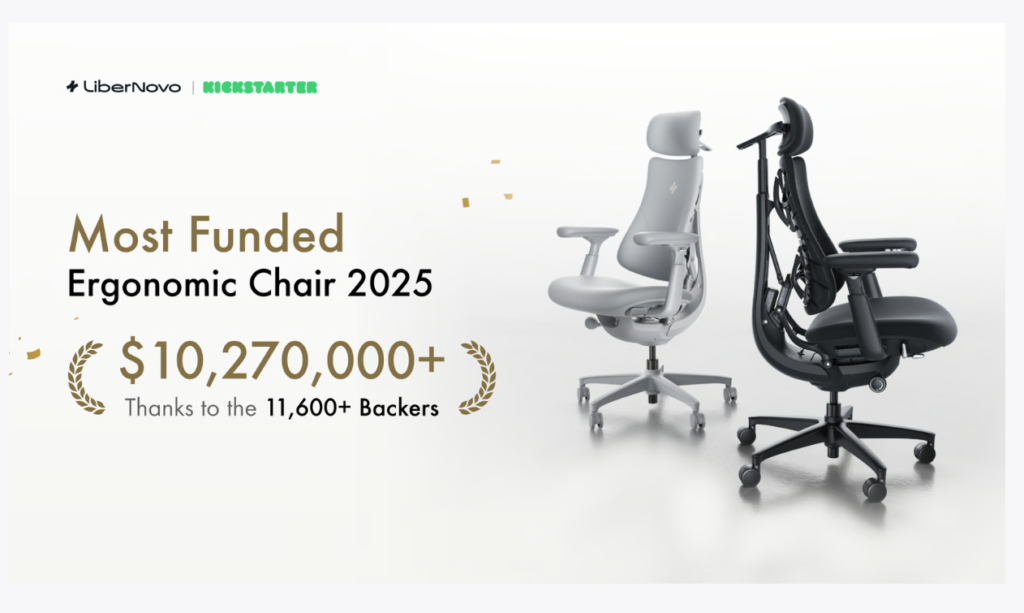
Their own product and science pages talk about pressure mapping suits, internal labs, and claims like “delivers the lowest seat pressure of any ergonomic chairs” and “99 percent of our test users rated Omni’s comfort and relaxation higher than leading massage products.”
The retail site stacks that on top of “BIFMA tested,” “30 day risk free trial,” and a warranty that sounds good on paper.
On paper, this looks like a serious engineering driven company.
In practice, every door I opened led not to engineers or a founder, but to one inbox: [email protected].
Kickstarter backers: this is the part brands love to bury
LiberNovo did not just launch a chair. They launched a hype machine.
The Omni chair exploded on Kickstarter off the back of a constant social media blitz. It raised over 9 million dollars. That is a budget.
Here is why I care.
Kickstarter is not a store. It is a risk transfer.
As I have said publicly before (in a completely different category, but the principle holds):
“When you are doing a Kickstarter, you are handing off the responsibility of your project to the consumer.”
“Kickstarters make people froth at the mouth. It is almost like gambling.”
“Companies work for you. You do not work for companies.”
If you want the full context on why I am skeptical of Kickstarter hype, here is the piece where I break it down in detail:
- Lofree Flow V2 review and my Kickstarter stance
https://craftingworlds.com/lofree-flow-v2-review-a-stunning-keyboard-held-back-by-a-design-misstep/
Now add this to the mess.
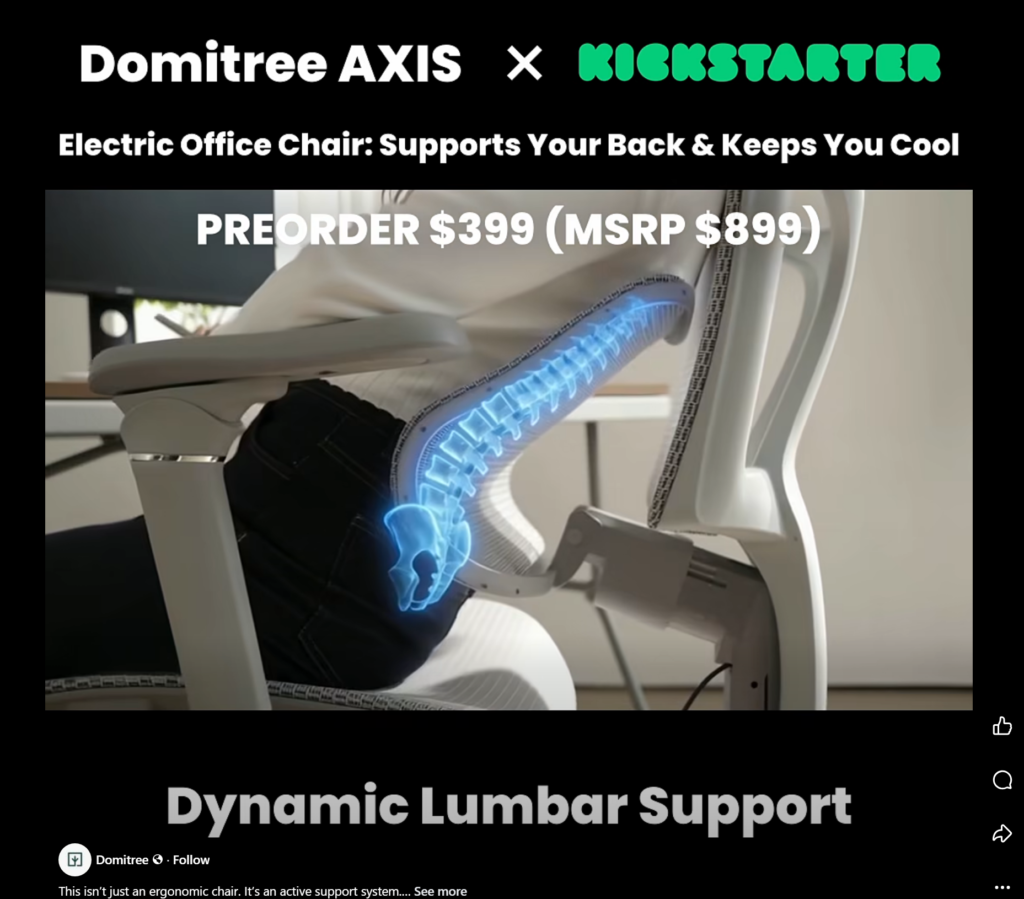
There are already knockoffs of the LiberNovo concept going around, like a “Domitree” reel that looks ready to start the cycle again. It looks like it will be a Kickstarter, and we know how I feel about Kickstarters:
Now layer on what paying customers are saying.
One Reddit user summed up the optics in a way that hit hard:
“It seems like LiberNovo has no problem shipping chairs (for free) to the YouTubers to get reviewed; but when a paying customer wants one there is no one to be found.”
– colink187 (https://www.reddit.com/r/OfficeChairs/comments/1phjrzd/libernovo_omni_customer_service_nightmare/)
That is one of the most damning optics problems a company can create.
And yes, you will see big creators cycle through “this is my new chair” moments during a marketing blitz. One example people pointed out to me: UrAvgConsumer talked about the Omni as his new chair and then a few months later it was nowhere in sight and he was back to talking about his favorite Corsair chair in a 2025 end of year setup breakdown. That is not hyperbole, it’s the truth. It is just an example of how fast these hype waves move.(I have zero issues with him doing sponsored content, that is NOT the focus here nor should it be)
Now apply that lens here.
A chunk of the complaints I found are not “I do not like the chair.” They are “I gave you money months ago and you vanished.”
And it gets worse when the marketing machine keeps spinning while backers and buyers say they cannot get support.
That is the part brands love to bury: the gap between the public hype and the private reality.
If a company builds momentum through hype, creator marketing, and crowdfunding energy, then it has a responsibility to prove it can deliver, support, and stand behind what it sells.
A lot of people do not feel like LiberNovo is doing that.
Part 1: How They Courted Me
In late 2025, Cassie from LiberNovo’s “media team” reached out to my business email.
The pitch was flattering and pretty standard:
- They said they had been watching my content.
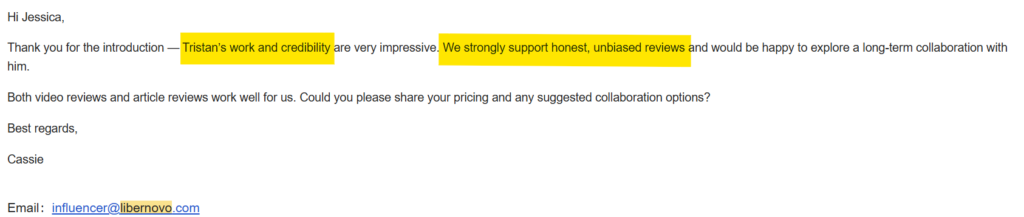
- They said they valued my honest, long form reviews.

- They invited me to review the Omni chair with full access to their team and pressure mapping and tech.(which never actually happened even when requested)

What was not standard was the budget.
After some negotiation, they agreed to my Full Editorial Review package: TEN TIMES my NORMAL RATE for a deep dive video, a short, and written review.
That is abnormal for a large, established brand with a long track record and deep support infrastructure.
It is a big bet for a very young brand whose entire story is a Kickstarter and a marketing blitz.
But they said they wanted a real review, not an ad. That is what I do. So we went to contract.
They also laid it on thick in those early emails about how much they loved my style.
“We appreciate the in depth, honest nature of your reviews and believe your expertise and unique style of content creation would be a great fit for our brand.”
“We value transparency and authenticity, and we want you to feel completely free to share your genuine thoughts about our chair.”
They said all the right words about honesty.
Then we saw what their actual contract said.
Part 2: The Contract That Was Supposed To Make Honesty Safe
The first draft they sent looked like every bad influencer contract I have ever seen, but it is worth being specific here because the exact wording matters. But let it be known, I have been in this industry and the entertainment industry for a long time, I have a marketing manager, I have some legal support. For your everyday influencer, this is the contract they get and agree to!
In their version, under “Additional Requirements” and “Review Items,” the Brand wanted full control of the idea, script, drafts, and final approval. For example, their language included lines like:
“Influencer will confirm the video script, idea, topic and theme with the Brand for approval before shooting the video.”
“Influencer will have to send the idea draft first before shooting for approval and the Brand will give some suggestions and requirements about the idea draft.”
“Influencer will have to send the video draft before publishing and make two (2) round of edits according to the Brand’s suggestions and requirements if the content is not aligned with the Brand’s Brief. If all the revisions are not completed, an additional round of editing will be required.”
“Influencer will have to obtain the final approval of the Brand before officially publishing the video(s).”
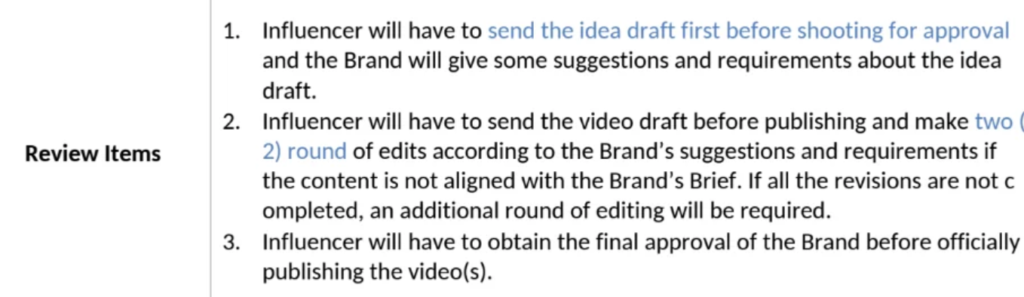
That is not a review. That is an ad script with my face on it.
Our edits ripped that control out and replaced it with something very different.
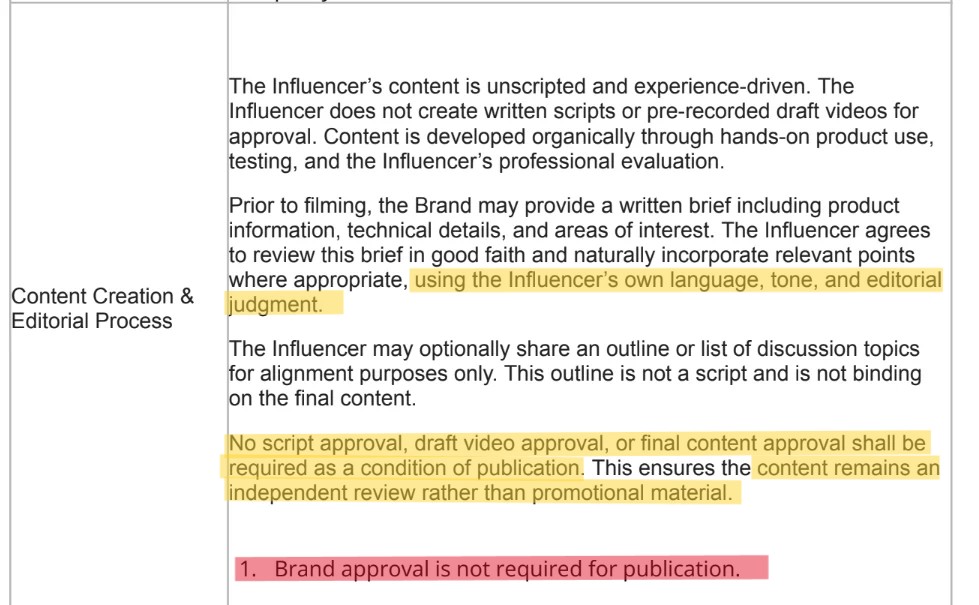
In the redlined version that became the final contract, we:
- Struck the idea draft and script approval requirement.
- Struck the “two rounds of edits plus more if needed” language.
- Struck the “final approval of the Brand” clause entirely.
- Clarified that any pre publication discussions would be optional collaboration, not mandatory approval.
- Limited their usage rights to reasonable, clearly defined promotion, not unlimited ad usage.
We added language that made it explicit that this was a paid editorial review, not a work for hire ad buy. In plain English, the signed version meant:
- I have full editorial control over what I say and how I say it.
- The Brand can request corrections if I get a factual detail wrong.
- The Brand cannot force script changes, cannot demand cuts to my opinions, and cannot block publication because they dislike my conclusions.
- The Brand cannot withhold payment because they disagree with my subjective evaluation.
That last point is not vague intentionally. It is spelled out in the payment terms we added:
“The remaining fifty percent (50 percent) shall be paid within 5 business days of publication of video and may not be withheld due to disagreement with the Influencer’s opinions, conclusions, or subjective evaluation.”
Normally I take payment upfront to prevent what inevitably happens next(using the payment as leverage), but this was a large contract. We did not change their payment obligations to make things easier on us. We just removed the ability to treat me like a freelance editor of their ad copy.
When both sides signed that version, we had a clear deal.
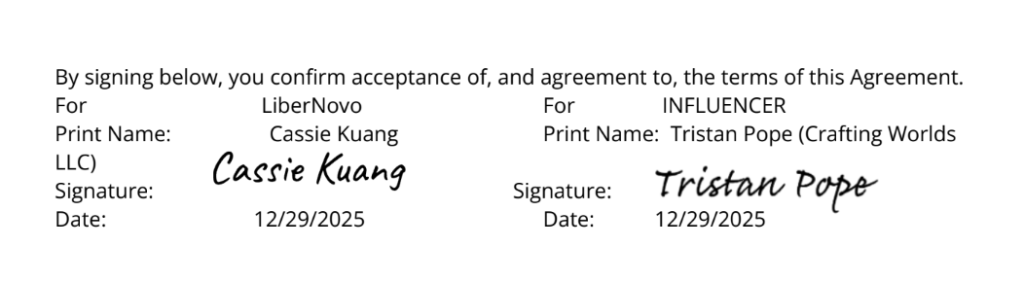
At that point, this should have been simple: they ship the chair, I test it, I publish my honest review, they pay the remaining fifty percent, everyone moves on.
Instead, the story basically starts after the contract was signed.
Part 3: My Track Record – I Get Paid To Tell The Truth, Not To Shill
Before we get deeper into LiberNovo, I want to be clear about something.
This is not my first difficult review. It is not my first time saying “this is not ready” about a product that paid me.
I have published negative reviews and exposés that would have been easier to keep quiet. And yes, it can be bad for business in the short term because brands do not love paying someone to say “this is not ready.”
Here are a few examples:
- HBADA E3 ergonomic office chair review – a piece of junk:
https://craftingworlds.com/hbada-e3-ergonomic-office-chair-review-a-piece-of-junk/
HBADA hired us afterwards to work with them behind the scenes, having focus groups with more chairs for feedback so they could fix it. That is what an actual company looks like when they take criticism seriously. - Elgato Embrace review:
https://craftingworlds.com/elgato_embrace/
Even Elgato sent us our payments and lets us be honest. They do not have to love every line in a review to honor a contract. Props to them. - Gaming chair takedown – “Stop wasting money on gaming chairs until you see this”:
https://craftingworlds.com/stop-wasting-money-on-gaming-chairs-until-you-see-this/
After that one, a marketing rep literally called me with their baby crying in the background because they were terrified my honest review was going to cost them their job. This is the work environment Libernovo felt like it fostered.
That is the reality on the other side of these videos.
That is why it matters that creators and consumers stay aligned. Reviews are supposed to make products better, not just move units.
We are not their advertisements, even though a lot of companies try very hard to turn us into exactly that and then pit the creator against the consumer instead of allowing a united front of creator and consumer holding them accountable.
Keep that in mind as you watch how LiberNovo reacted when honesty stayed on the table.
Part 4: The first attempt to move the goalposts: “try it first… then we’ll decide”
After the contract was already signed, we were told the new approach would be:
“At the start, we just need to focus on the product evaluation stage (try the chair) to confirm whether you like it. If it meets your expectations, we can move forward with the full package as per contract.” – LiberNovo (email)

“Once the influencer has tried the product, if it meets expectations, then we move forward with the full package as per contract.” – LiberNovo (email)
Read that slowly.
That’s not how a signed agreement works. You don’t get to add a new checkpoint that basically says: if you like it, we proceed. If you don’t, we don’t.
That is literally the opposite of an independent review. It turns the contract into a soft-paywall for positivity.
We declined as the contract was already signed and my marketing manager attempted to explain that was not part of the agreement in writing.
On January 3, 2026, they reversed course:

“After completing further internal review and discussions with our compliance and risk control teams, we regret to share that LiberNovo will not be able to proceed with execution of this collaboration… As such, we will not be moving forward with product shipment, payment, or any other performance under the agreement.” – LiberNovo (email)
They also added:
“This decision is not a reflection of Tristan’s professionalism or reputation…” – LiberNovo (email)
So what changed between “we value honest independent reviews” and “risk control says no”?
Nothing.
It was the holidays. I hadn’t posted anything new about them. I hadn’t received the chair. I hadn’t even had the chance to review it.
The only meaningful change was this:
- They signed the agreement.
- The agreement protected editorial independence.
- Suddenly, honesty became a “risk.”
My team and I asked what the risk actually was. We asked what changed. We got AI slop instead of a straight answer.
We eventually had to say this out loud in the thread because it was getting messy:
“Please stop using AI as it is not writing contextually correct information and it is hard to follow.” – Crafting Worlds team (email)
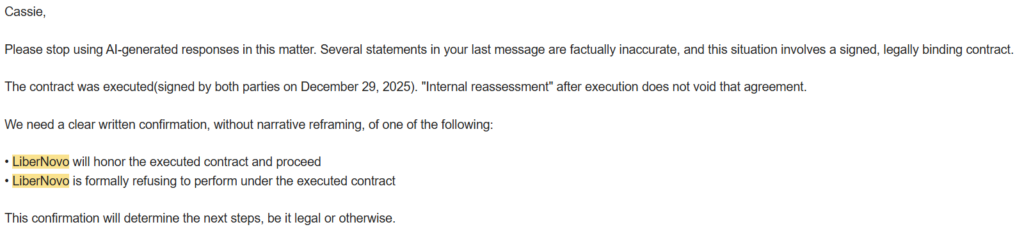
In many cases it was actually arguing our case as it was quoting fairness laws.
Then they admitted the agreement is legally effective, while still refusing to perform
Later that same day, they wrote:
“LiberNovo does not dispute that the Agreement was signed by both parties and is legally effective.” – LiberNovo (email)
“LiberNovo does not accept the yes-or-no framing of your question and reserves all rights.” – LiberNovo (email)
Read that again.

They acknowledge the contract is signed and legally effective.
Then they say, in lawyer-speak: “We’re not doing it, and we’re not answering you.” in response to Jessica asking if they would be honoring it.
That is the entire reason I went public.
Part 5: Going Public, Reddit, And The DeskHaus Detour
While all of this was happening, LiberNovo was everywhere.
Tech sites, YouTube channels, Instagram reels, and TikTok clips were praising the Omni as the next big thing. A lot of that content looked and sounded like paid coverage, even when the disclosures were vague.
Behind the scenes, I had a signed contract and an email telling me they were not going to perform under it.
I did what I always tell smaller creators to do when a brand tries to quietly make a contract disappear. I went public with the facts.
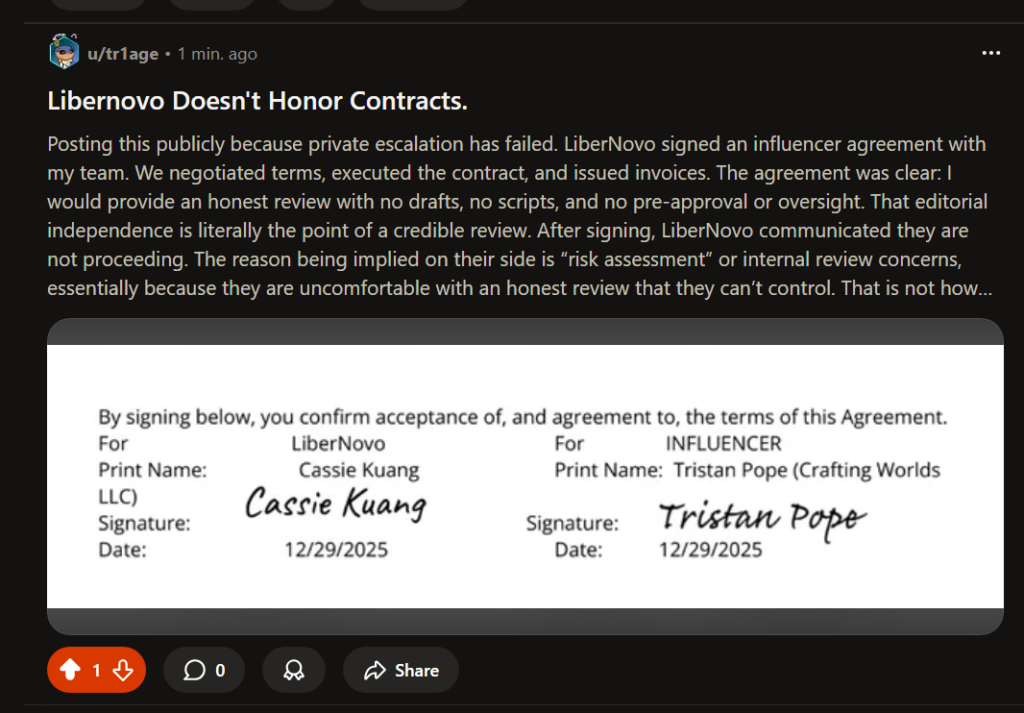
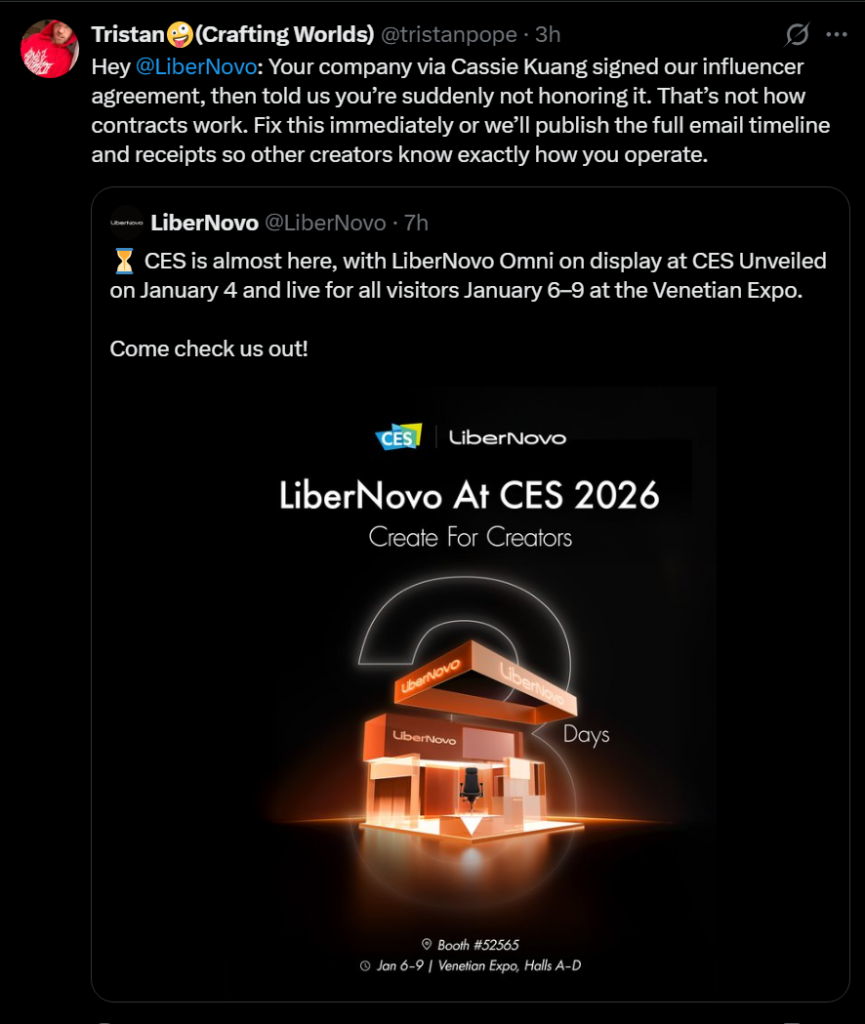
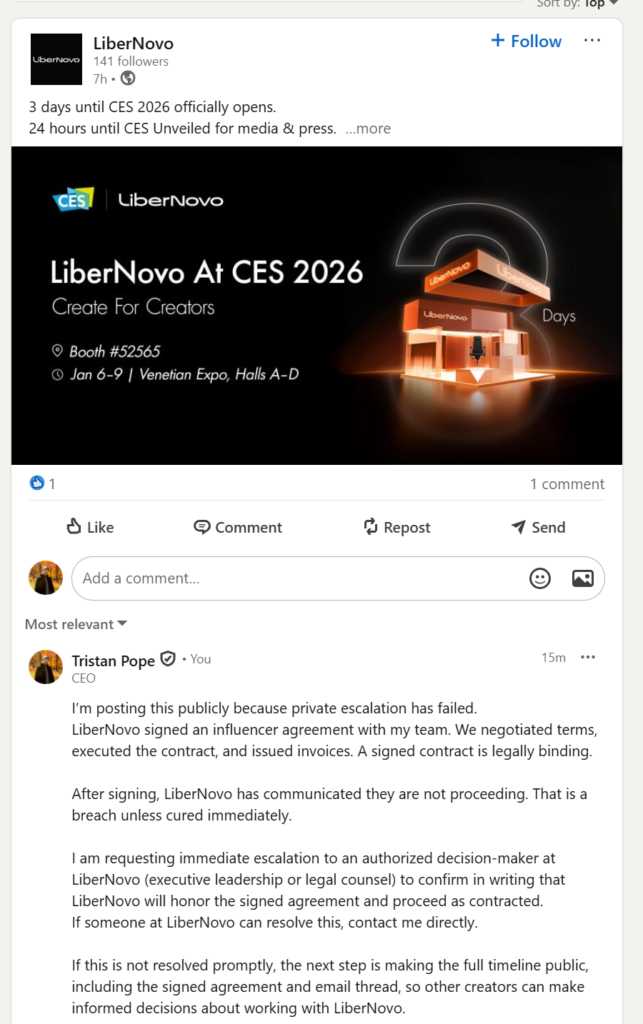
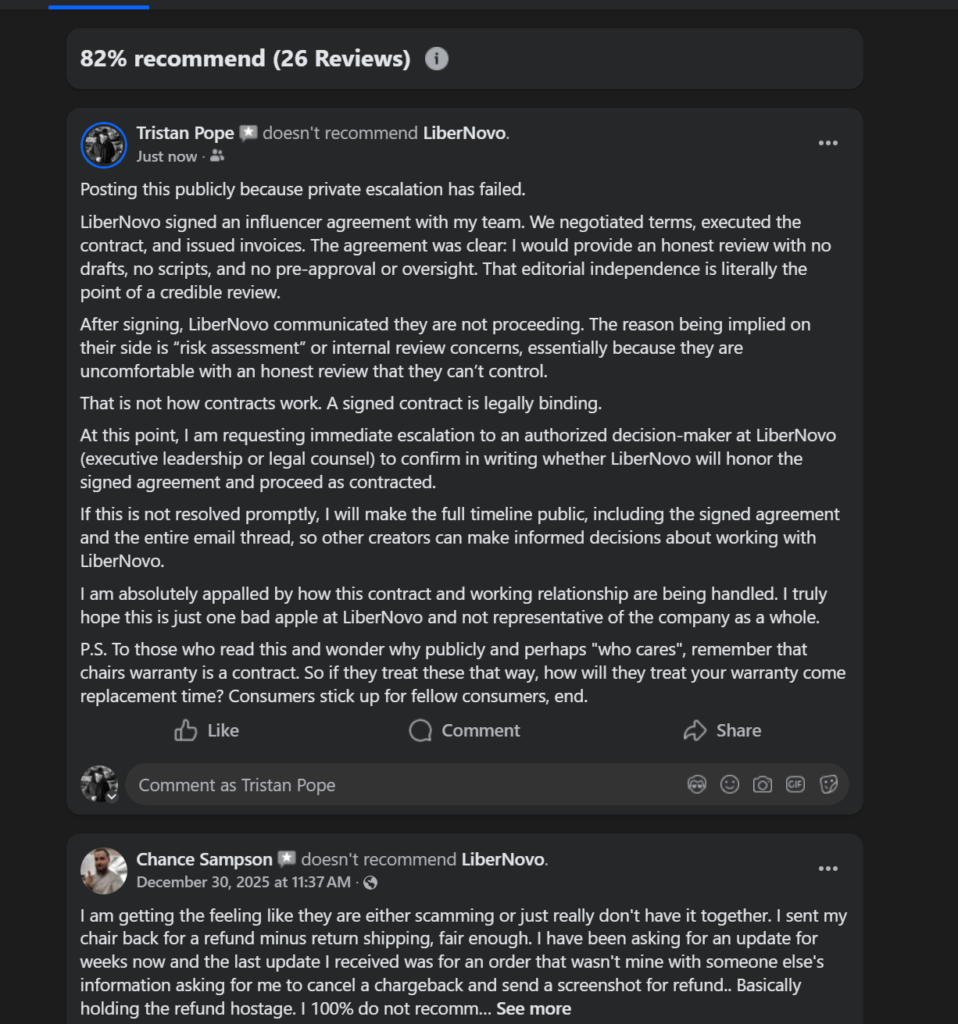
On X, LinkedIn, and Reddit I posted a simple version of the story:
- LiberNovo had signed a contract for a fully honest review.
- They are refusing to acknowledge said contract and have cut communications.
Most people understood exactly what that meant. Some supported me. Some asked hard questions. And then you have others who just want to bring down those around them, because, Reddit.
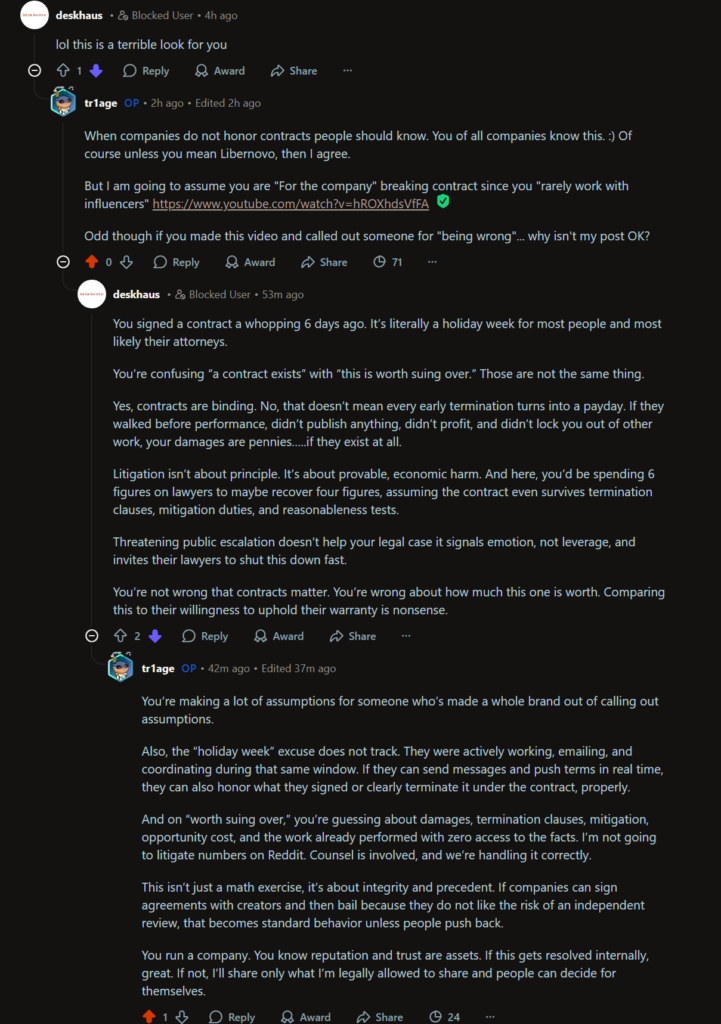
To be clear, this story is not about DeskHaus. It is not about any competitor. It is about how LiberNovo handled a contract they had already signed.
The reason I mention Reddit and LinkedIn here is simple. Brands count on you saying nothing. They hope you will disappear quietly rather than risk looking “difficult.” What Deskhaus did is an example of a company that has lost touch with the consumer and is willing to pit people against each other so they can come out on top.
It sucks, because before this, their ethos actually seemed pretty good. But this shows that even if a company has a strong product, the people behind it can still bring that reputation down a notch. They’ve even have and use multiple accounts, and if you want to avoid engaging and take the high road, you have to block both. Yet they still feel the need to jump into conversations that have nothing to do with their company. For example, jumping into a LiberNovo chair Reddit just to argue and get the last word, even though they don’t make chairs and weren’t part of the original discussion. I’ve seen this behavior before in the industry. It happened when I gave an honest review of the Haworth Fern and the owner of BTOD responded in a similar way. It’s strange. The whole thing is strange.
I genuinely get happy when someone finds a product they love, even if I don’t. What I don’t get excited about is seeing a pattern of behavior from companies that may not honor warranties, may not respect creators, and may not operate with the kind of business practices they publicly claim to stand for. That’s the real issue here.
Part 6: Why this matters to regular buyers
I know exactly what some people think:
- “Just sue them.”
- “Creators are entitled.”
- “This is just attention seeking.”
Here is the reality.

“Just sue them” is a fantasy for most people
This is not small claims court.
This is cross-border. The legal friction alone is a wall. Add resources, time, jurisdiction, and the fact that big companies can drag things out until you bleed money.
That’s why companies do this. They count on the fact that enforcement is painful.
And I’m not here screaming “lawsuit.” I’m here saying: you don’t get to normalize this behavior.
Because if a company is willing to sign something, acknowledge it is legally effective, and then refuse to perform anyway, you should absolutely be asking what happens when you need support.
Not as a gotcha. As basic self-preservation.
If I am such a “risk,” what specific risk are we talking about?
Risk of fraud.
Risk that I do not deliver.
Risk that I will say out loud what I find if the chair has problems.
No answer. Just “internal processes” and “risk control” and “not at this time.”
Going public did three things at once:
- It made it much harder for them to pretend the contract never existed.
- It gave other creators a heads up about what was happening.
- It made sure any private gaslighting had to stand next to public receipts.
Which is exactly the point where Amanda appeared.
Part 7: The Amanda Call, The Walk Back, And The Cultural Excuse
Once I went public about the contract situation, I finally got traction.
After those posts, I got an email from Amanda, a marketing manager at LiberNovo:
“I’ve seen your recent posts, and I totally get you’re frustrated about how this collaboration has gone… I’d like to hop on a call with you… to figure out a resolution that works for both sides.”
We got on a video call in early January 2026.
On that call, which I recorded and later transcribed, a few important things happened.
First, Amanda was apologetic and direct:
“I’m so sorry. It is our fault.”
Second, she confirmed that the contract was valid and should be honored as written. There was no actual legal dispute about its existence or enforceability.
Third, the explanation for how we got here drifted into culture and “old school” habits. She described Cassie, the person we had dealt with before, like this:
“She is not good at to talk with American people because she live in China for a long time.”
and framed some of the behavior as:
“You know, some of this is just old school Chinese ways.”
That “old school” framing was used as a shield. As if the problem were simply cultural misalignment and clumsy communication.
But here is the problem.
It does not matter where you live or how you prefer to do business. You do not get to sign a contract, admit it is legally effective, and then treat the other side like they are asking for a favor when they expect you to honor it.
The soft control angle also showed up very clearly in how Amanda relayed what Cassie had wanted instead of honoring the deal as signed:
“Can I send you the chair first and then if you like it, you make a review, but if you do not like it, you just…”
Read that again.
That is not an independent review contract. That is “we only pay if the vibe is positive.”
And it did not stop there. Amanda also passed along a clear ask about my public posts:
“Can you delete this content on other social media. LinkedIn and Instagram… It will look bad to my bosses, ya know?”
A brand asking you to delete public statements while they are simultaneously refusing to perform under a signed agreement is not a “miscommunication.”
It is reputation management.
To Amanda’s credit, the outcome of that call was at least clear on paper. After we hung up, she sent a follow up email that said:
“As we discussed in the call, we will absolutely move forward with the contract as originally agreed. We will send the chair to you right away, and we will process the 50% payment before we officially begin the collaboration. Once the review is completed, we will then process the remaining 50% as scheduled.”
So at this stage the message was:
- “We messed up.”
- “We will fix it.”
- “We will pay.”
- “We will honor editorial independence.”
- “We will do all the above, ONLY if you remove your current social media posts.”
We agreed on one thing: they would restart the contract as originally signed. No new clauses. No new censorship.
I agreed to remove posts that specifically referenced the contract dispute once the chair arrived and the first payment cleared, because at that point the immediate dispute would be resolved.
I did not agree to pretend none of this happened.
They then introduced Eileen as the new point of contact.
On January 8, 2026, Eileen emailed to collect my height and weight, confirm configuration, and ask for invoice details. The chair shipped shortly after, with a FedEx tracking number.
On January 11, 2026, we confirmed the chair and footrest had arrived.
At this point, most stories would end.
This one does not.
Part 8: Eileen, A Single Inbox, And A Company That Felt Like Marketing All The Way Down
After the Amanda call, we got handed off again, this time to Eileen.
But again using a single inbox: [email protected]. Every reply, no matter whose name was at the bottom, came from that same address.
Sometimes it was signed Cassie.
Sometimes Eileen.
Sometimes another name.
For all I know, I spoke to the same person the entire time. Or five different people who could not see each other’s notes.
Either way, one thing was obvious: I never once heard from a lead engineer, a founder, or anyone with visible authority over the product itself, even though I requested it.
It felt like marketing all the way down. Marketing asking my height and weight. Marketing handling shipping and logistics. Marketing doing customer support. Marketing trying to sound like legal.
Eileen handled the practical next steps:
- She requested our invoice for the first fifty percent.
- She confirmed shipment and sent tracking.
- She told us the pressure mapping suit they originally dangled was actually not available.
- She said the footrest would come in a separate shipment.
The initial payment arrived.
The chair showed up.
The footrest followed later.
On paper, everything was now back to normal.
I knew better than to treat it that way.
Part 9: Sitting In The Omni – The Good And The Bad
Here is the email I almost sent to Eileen and Amanda. I never hit send. You are reading it because this is the unfiltered feedback I had in my notes while I was testing the chair.
The good
- The aesthetics. It looks premium. The design photographs well. It fits nicely into inspo photos.
- The back massager and stretch modes. The spinal traction and massage functions actually feel good in short bursts. I am concerned about it for health and safety reasons, but I will let an engineer speak on that where I cannot.
- The headrest. Genuinely excellent. Easy to adjust, locks where you want it, soft and supportive.
- The material softness. Out of the box, it feels plush and soft against your skin.
- The armrests in theory. There is minimal lateral wobble in the pads themselves when you are not pressing the buttons. (check cons though for no locking mechanisms and sliding)
- Battery life. The motorized features can run a long time between charges.
- Asynchronous arm movement. When you recline, the way the headrest and arms follow you feels similar to what I love on my Steelcase Leap.
- The footrest. For desks around 29 inches or higher, the StepSync footrest is genuinely useful.
If that was the whole story, I would call this a promising first effort with some quirks.
It is not the whole story.
The not so good
- Armrests with no tension. The pads slide with almost no resistance. Bump them and they move. Try to push yourself up and they shift under your hands. Over time this is a safety and comfort problem.
- Recline positions that do not match real work. You get a few fixed positions, not a continuous range. One feels too upright and pushy for focused work, the next feels too laid back and “movie mode.” You end up fighting the chair instead of dialing it in.
- Tension adjustment is finicky. The recline tension knob takes multiple full turns before you feel a change. Overshooting is easy. Fine tuning is not.
- The cushion bottoms out. After two to three hours at a desk, my sit bones and tailbone ache. For a chair that claims cutting edge pressure relief this is not great.
- Seat pan design wastes usable depth and is not the stated depth due to the positioning of the back. I found the longer length (Listed as 48CM) to be “max” 40cms if not 38cm with the soft edge!
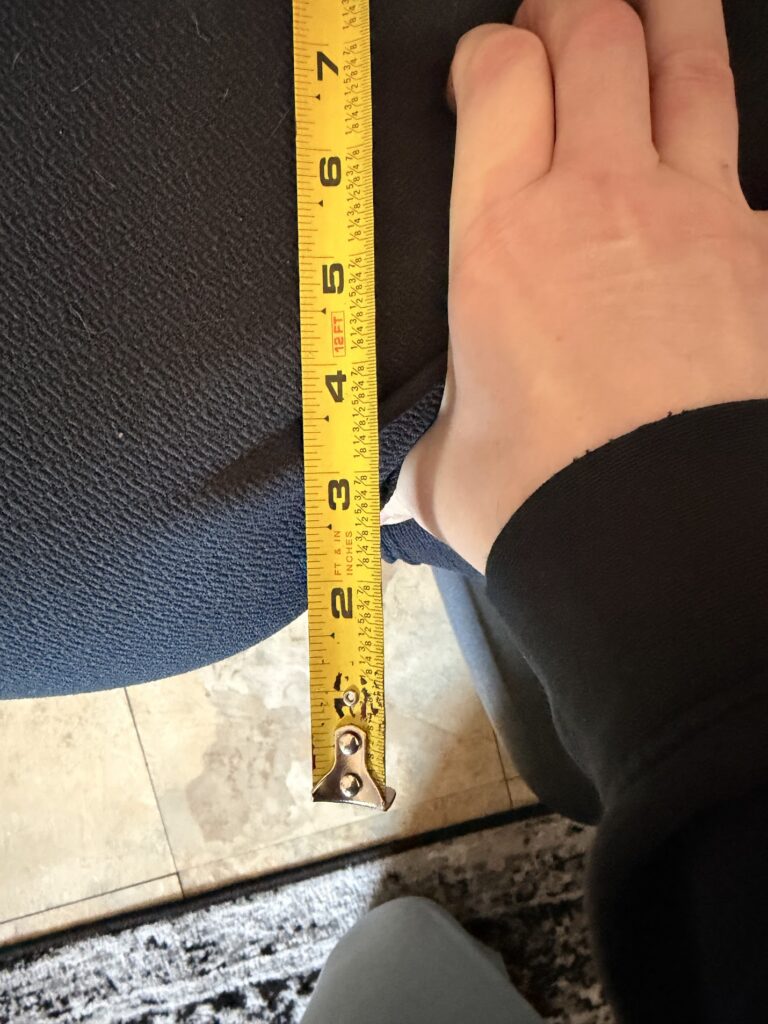
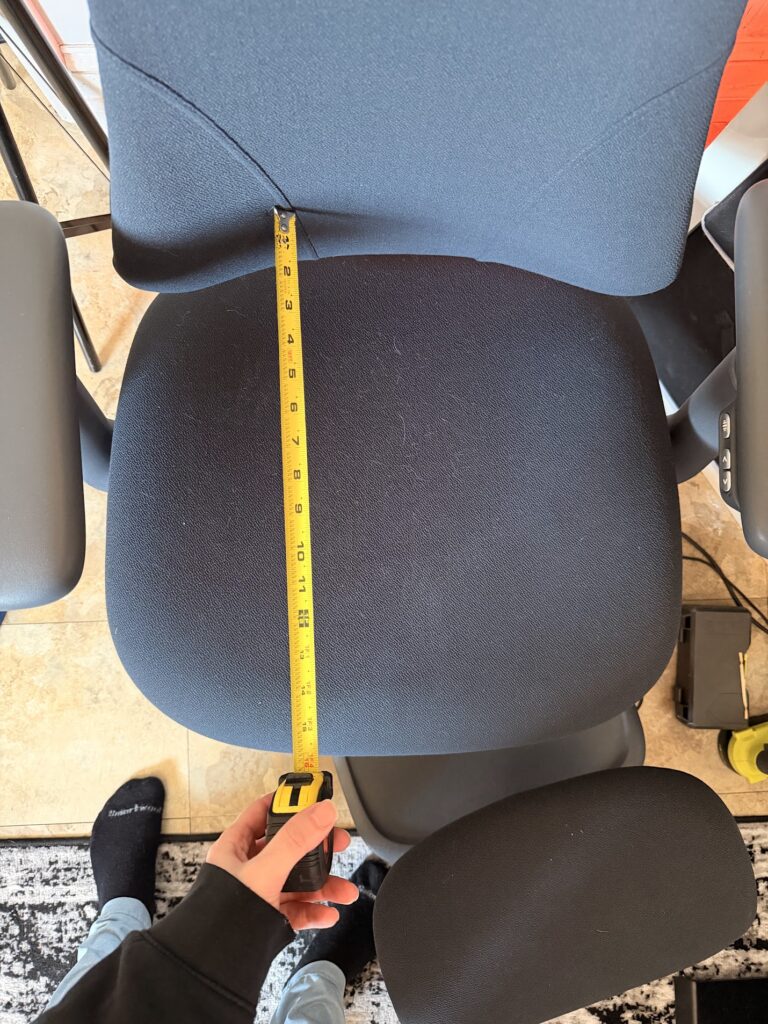
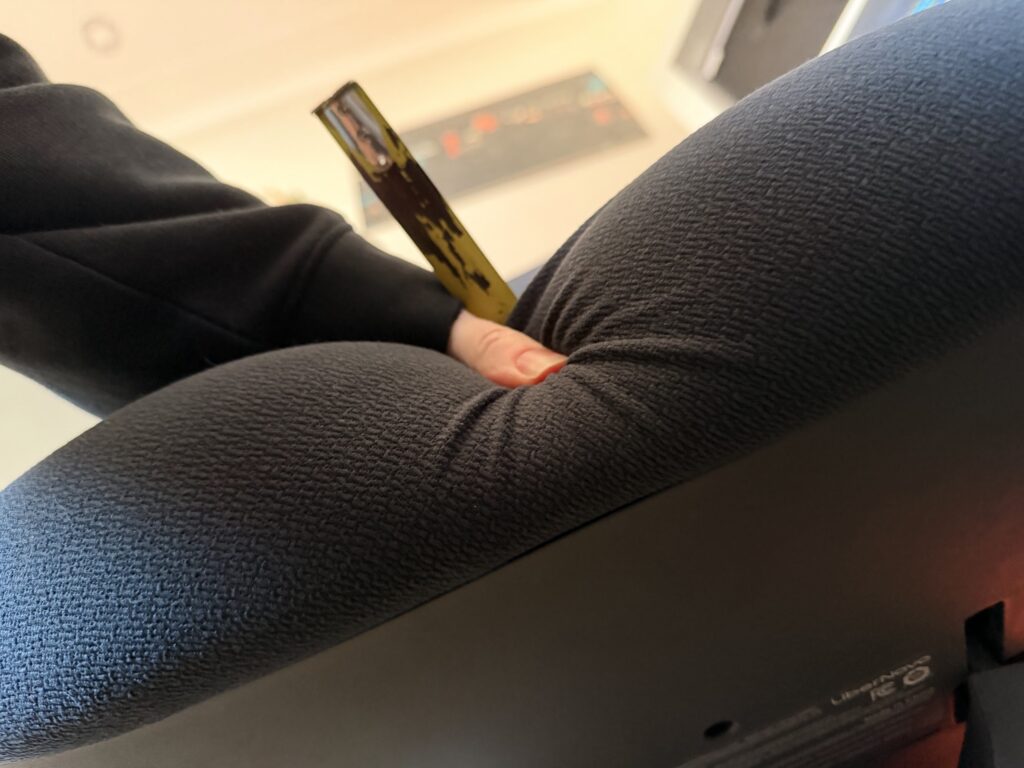
- The front of the cushion has a soft, unsupported overhang to make that “48 cm claim”. You feel like you are sliding out of the chair. You cannot adjust seat depth, so if your femurs are longer than their one design target, you are out of luck.
- Lumbar is not truly adjustable. The “dynamic” back sounds good on a landing page. In practice it means you are constantly micro adjusting your posture to stay in the sweet spot. Pair that with non locking arms and you are doing a lot of work to stay still.
- Buttons in bad places. The left armrest buttons are easy to hit by accident when adjusting the chair. I triggered massage when I did not want it more than once.
- Fabric durability questions. The soft, plush fabric feels great now, but it grabs clothing. I worry about snags, pilling, and discoloration over time, especially for jeans and anything with hardware.
- Creaks and flex. Over longer sessions, the back feels less like firm support and more like soft plastic flexing. You end up doing subtle core work to stay upright instead of letting the chair carry the load.
- No charger included. You buy a battery powered, motorized chair and have to sort your own charger.
- Perpetual sales. Every time I looked at their site something was “limited,” “ending soon,” or “early bird.” It feels less like a limited promotion and more like those stores that are always going out of business but somehow never close.
None of these issues alone would be catastrophic if LiberNovo had simply said: “We are a new brand with a very soft, tech forward chair that some people will love and some will not, and we are going to keep iterating.”
The problem is that their science story does not line up with the actual experience in the seat.
Part 10: Evidence Of Copied Marketing Assets – The “Science” Problem
This is where I went from annoyed to genuinely concerned.
Because the contract issue is one thing. But the moment you see questionable marketing practices layered on top of support complaints, the trust problem becomes systemic.
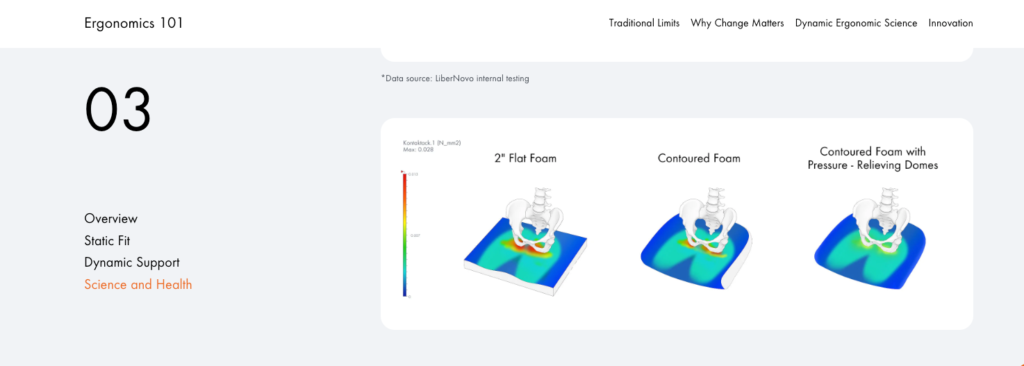
I found evidence that LiberNovo’s marketing appears to reuse ergonomics visuals that match Anthros’ published materials. (these are still live as of publishing this article!)
Image comparison
Anthros original page screenshot

LiberNovo science page screenshot using the same pressure map style visuals
Ad usage
LiberNovo ad using Anthros style skeleton overlay imagery in front of an Omni
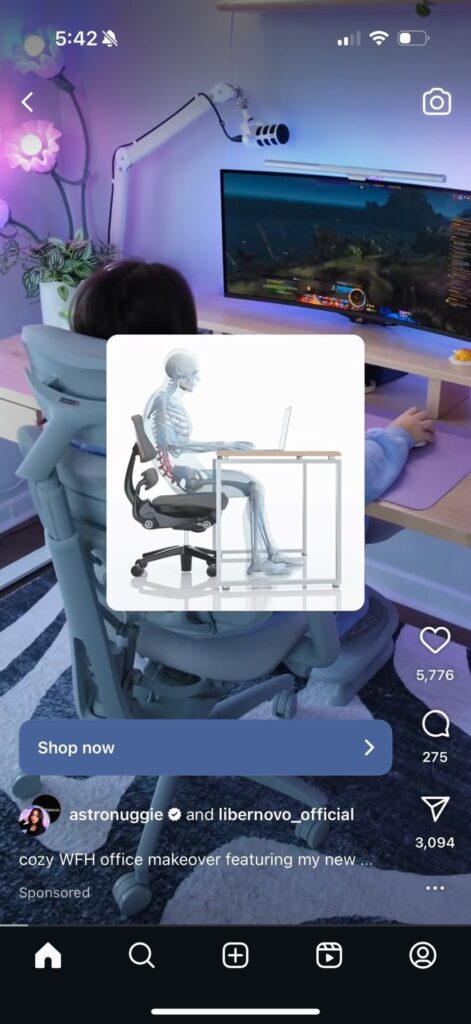
Related link STILL being used and sponsored by Libernovo with 3.5 million views:
If LiberNovo wants to be taken seriously, this is the kind of thing they need to fix immediately.
Anthros’s Website:
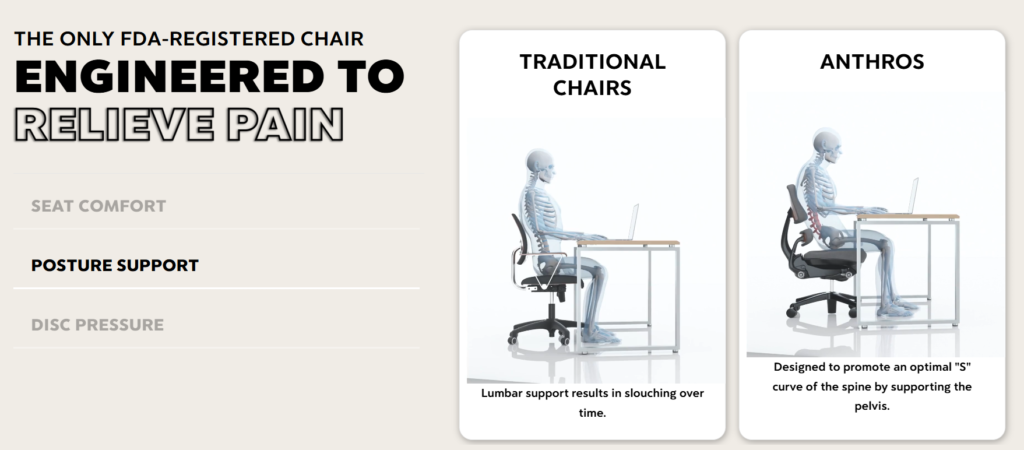
And yes, I know how this sounds.
But the screenshots are right there. Look with your own eyes.
If a company is comfortable “borrowing” credibility in public, I do not trust them to suddenly become accountable in private.
Are they straight up LYING about their chair’s “research and development”?
Part 11: The Science Story That Starts To Look “Borrowed”
LiberNovo’s marketing leans hard on science.
They talk about pressure mapping.
They talk about internal labs.
They talk about disc pressure, core engagement, and ergonomics.
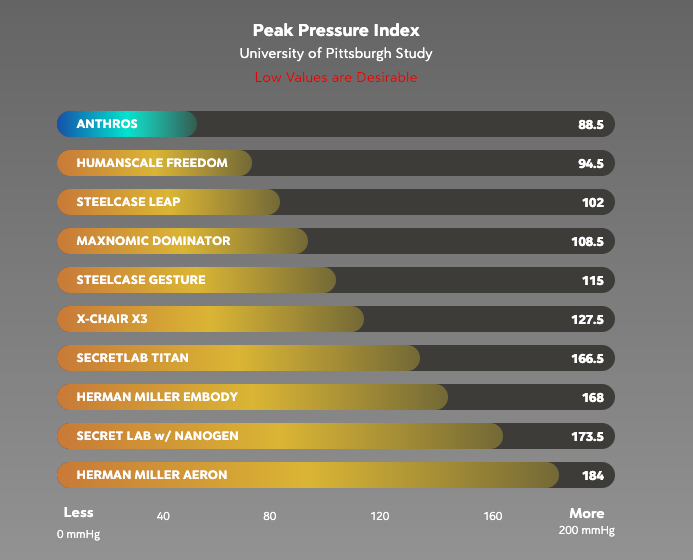
Anthros:
Libernovo
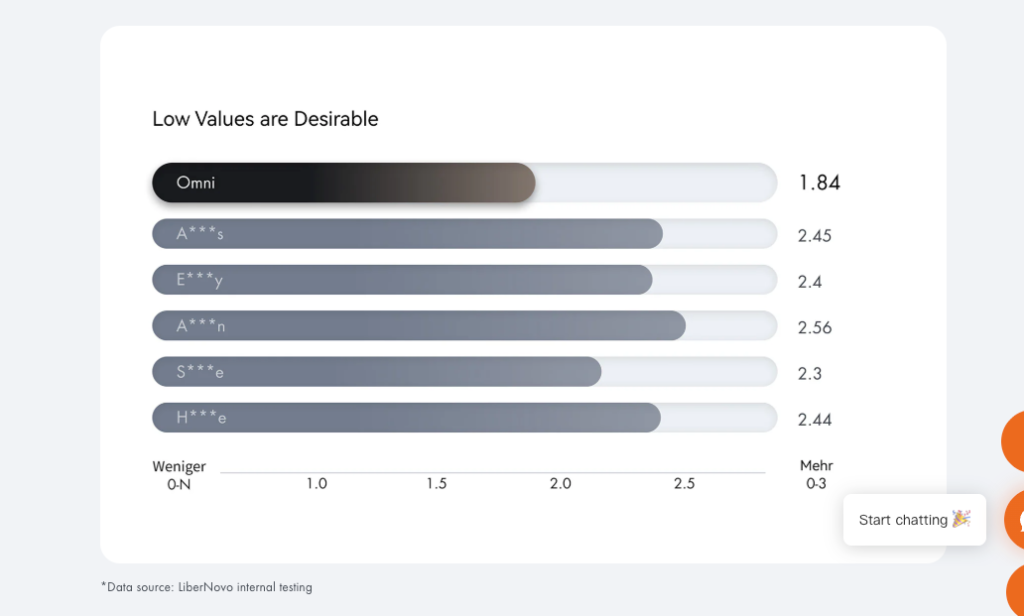
If you read their “Dynamic Ergonomic Science” page, you see testers in pressure suits, colorful pressure maps, and bold claims about lowest peak pressures and long term comfort.
If you also read Anthros’ science pages, some of those visuals start to feel uncomfortably familiar.
Anthros is a different chair built by people who came out of wheelchair seating and medical device work. They show a series of pressure maps that compare:
- two inch flat foam
- contoured foam
- contoured foam with pressure relieving domes
They did that work with the University of Pittsburgh and publish the methodology and results.
In LiberNovo’s marketing materials you can find imagery that appears visually identical to that Anthros experiment. Same pelvis. Same three stages. Same colors. Same “pressure relieving domes” framing. Except now it is sitting in front of the Omni.
Only Anthros and LiberNovo can say if there is a licensing agreement behind the scenes. I am not making a legal claim about copyright here.
I am saying this as a reviewer who works with brands that actually do multi year R and D:
- If your “science” visuals come from someone else’s research, you owe your customers clear attribution.
- If you dress your product in another brand’s lab coat without telling anyone, that is at best sloppy and at worst deceptive.
- And if the cushion people actually sit on feels like a soft block that bottoms out in a few hours, then whatever pressure mapping story you are selling is not what most people will experience.
The gap between the science narrative and the reality of sitting in the chair is exactly what an Amazon reviewer nailed with painful clarity.
MAJOR UPDATE!
Part 12: The Amazon Review That Nails The Problem
On November 21, 2025, a verified purchaser posted a long form review of the LiberNovo Omni on Amazon titled:
“The Ergonomics vs. Comfort Paradox”
I am going to include a big chunk of it here because it perfectly describes what I felt.
“The Ergonomics vs. Comfort Paradox: This is a classic paradox in ergonomics, and my personal experience illustrates the difference between immediate comfort and long term ergonomic support. Since I strained my back, and purchased a Libernovo Omni (LO) to see whether it can help the backpain for long term use. And I compare the experience with Herman Miller Embody (HME) which is considered the industry standard for ergonomic chairs. I bought a gaming version since it has more cushion and support.
With LO, I feel immediate comfort and softness, deep recline like a recliner (the wow factor), fully supported in a relaxed position, but after a long term use, strangely, I feel back pain again, so I investigate what causes the pain.
I found that the reason the LO causes back pain while the HME does not is rooted in two fundamental concepts:
- Passive vs. Active Ergonomics.
- The Strain of Deep Recline vs. Supported Neutral Posture.
The key difference lies in what the chair encourages your muscles to do.
The purpose of ergonomics is to apply theory, principles, and empirically tested data, and methods to design in order to optimize human well being and the overall system performance, not just comfort. The core principle of ergonomics is: fitting the job or product to the person, not the person to the job or product.
Ergonomics vs. comfort: While an ergonomic chair should ultimately lead to comfort, it is not vice versa. Comfort is a subjective and immediate feeling, whereas ergonomics is a scientific measure of safety and function.
Comfort
Comfort: A physical state of ease and freedom from pain or constraint; a subjective feeling of pleasantness.
• Focus: Immediate sensation (for example a thick cushion, soft material, and deep recline and massage functions).
• Measurement: Subjective (a person’s immediate feeling)
• Duration: Often temporary or short term use. A chair can feel comfortable for the first hour, but lack the necessary data for the support for 8 plus hours.
Ergonomics: A design philosophy aimed at optimizing posture, performance and well being, to prevent injury.
• Focus: Long term musculoskeletal health and spinal alignment.
• Measurement: Objective (anthropometry, range of motion, reduction of pressure points, electromyography, reduction in MSD risk).
• Duration: Long term use with empirical data and test methodology for the extended use.
In summary: A highly comfortable chair (like a plush armchair) can be non ergonomic if it forces your body into a static, unsupported position, which can lead to long term pain and injury. An ergonomic chair may feel “firm” or “different” at first, but its design is rooted in the science of supporting your body’s structure and promoting healthy movement.
A. Libernovo Omni (LO): Passive Comfort
The LO, with its immediate softness and deep, recliner like recline, likely employs a philosophy of Passive Ergonomics.
• Characteristics: feels good immediate support
• Softness and deep padding: A chair can feel comfortable for the first hour but lack the necessary support for the long term use like 8 plus hours. However, the padding and comfort take over all the work. The core muscles are deactivated. Over prolonged sitting, the static, relaxed posture leads to muscle stiffness, metabolite accumulation in the discs, and a weakening of the core musculature, causing pain when you move.
160 degree recline: Excellent for rest, napping, or watching a movie. It encourages a static, non working posture. Working from a 160 degree recline angle usually means your keyboard and monitor are poorly positioned, forcing your neck and shoulders to crane forward, leading to compounded upper back strain.
=> The LO trades structured support for immediate, pillow like relaxation. This may work for short periods but could punish the body during long work hours.
B. Herman Miller Embody (HME): Active Support
The HME, designed by doctors and engineers, uses Active Ergonomics (or Dynamic Sitting).
• Characteristics: Feels stiff initially.
• Stiffness and dynamic back: The seat and backrest (the “spine” and “ribs”) are designed to closely match and support the natural S curve of your spine. This forces your body out of any slouching position.
=> It encourages movement. The tension and slight instability of the back and seat pan allow for small, constant shifts in posture (micro movements). This movement helps circulate blood, pump nutrients into your spinal discs, and keep your core muscles slightly engaged, preventing the stiffness and strain associated with passive sitting.
Balanced recline. The recline mechanism is designed for a neutral, upright working posture (usually 100 degree to 110 degree) or a slightly relaxed one (120 degree), not deep rest. The recline is balanced by tension control that keeps your pelvis stabilized and neutral while the back moves. This takes pressure off the lower spine without letting your body completely slump, preventing the disc compression that leads to low back pain.
=> The Embody feels “stiff” because it is a tool built to hold your spine in a healthy, neutral alignment, rather than a piece of furniture built for lounging.
My experience suggests that the primary focus of LO is to design for comfort, allowing the body to slouch or remain in the unsupportive, static posture for too long, which could cause strain and disc compression, which is why my previous back injury flares up. On the other hand, the HME is likely keeping the spine in a properly supported, neutral position while encouraging the essential micro movements that prevent stiffness and pain. Hope this experience helps.”
You do not have to agree with every word of that to see the pattern.
This is exactly what I felt.
- Immediate wow factor.
- Deep, soft, recliner style comfort.
- Long term ache and fatigue when you actually work in it.
LiberNovo’s marketing frames the Omni as a solution for long work sessions.
The chair, and independent reviews like this one, tell a different story. So does science. “Soft and instant short term gratification, do not = ergonomic”
Part 13: The Customer Experience Story
While I was testing the chair and working through this contract mess, more public data points kept popping up.
On Trustpilot, LiberNovo sits at a mixed average. Yes, there are happy customers, many of them clearly invited by the company to post after delivery. There are also a lot of one star reviews that tell a different story:
A few examples:
“Customer service is non existent. Does not reply to emails and the phone number never goes through.”
– YQ (https://www.trustpilot.com/reviews/6956e121dcd6a4c11c89f727)
“I have called their phone number multiple times… The phone number immediately puts you on hold and then disconnects after a few minutes… I think they are simply trying to run out the 30 day clock on the return window.”
– John G. (https://www.trustpilot.com/reviews/6959f65de961e18a512c2f2f)
“The company moves from promotion to promotion selling chairs while they leave their customers hanging. Support is awful… This company treats customers like Kickstarter contributors.”
– C Dubs (https://www.trustpilot.com/reviews/695a95b9e06f78b4a7c6f595)
“The chair itself is nice, but I would advise you to stay away from the company.”
– Michael O (https://www.trustpilot.com/reviews/6959ad29a074f893c831aab1)
“CUSTOMER SERVICE IS TERRIBLE… they still have not authorized my return… I am still waiting for a response!”
– Ahmed (https://www.trustpilot.com/reviews/695adf99d7e90d7f93e4d9d7)
Those are not people nitpicking armrests.
On SiteJabber, one reviewer describes buying a deeper seat version, being verbally promised a return option, then being told they could not return at all, calling the return policy “a facade that they do not honor.”
Security and scam checking sites have also flagged the domain as high risk or “likely unsafe,” pointing to patterns like:
- a very young website
- unusually intense social media promotion
- a mix of glowing and angry reviews
- limited transparency around the company structure
None of this by itself proves fraud.
Taken together, it paints a picture of a company whose marketing and sales machine has outrun its support and logistics.
I truly believe, in my heart of hearts that the Libernovo Omni is a popup shop but on a scale like we have never seen before, with a budget we never believed possible. If this company is around in 2 years when your warranty is up, I will eat my words, but it has all the markings of previous companies that have shut down after the money grab. – Me
When I layer my own experience on top of that, the pattern is hard to ignore.
Part 14: Perpetual Sales, FOMO, And The Pop Up Shop Vibe
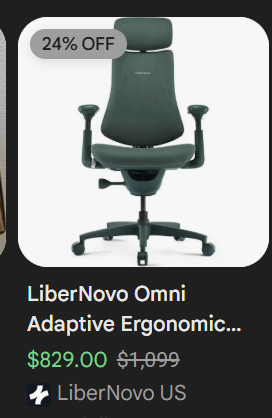
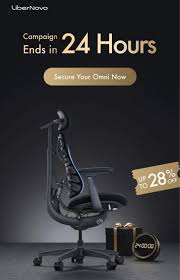

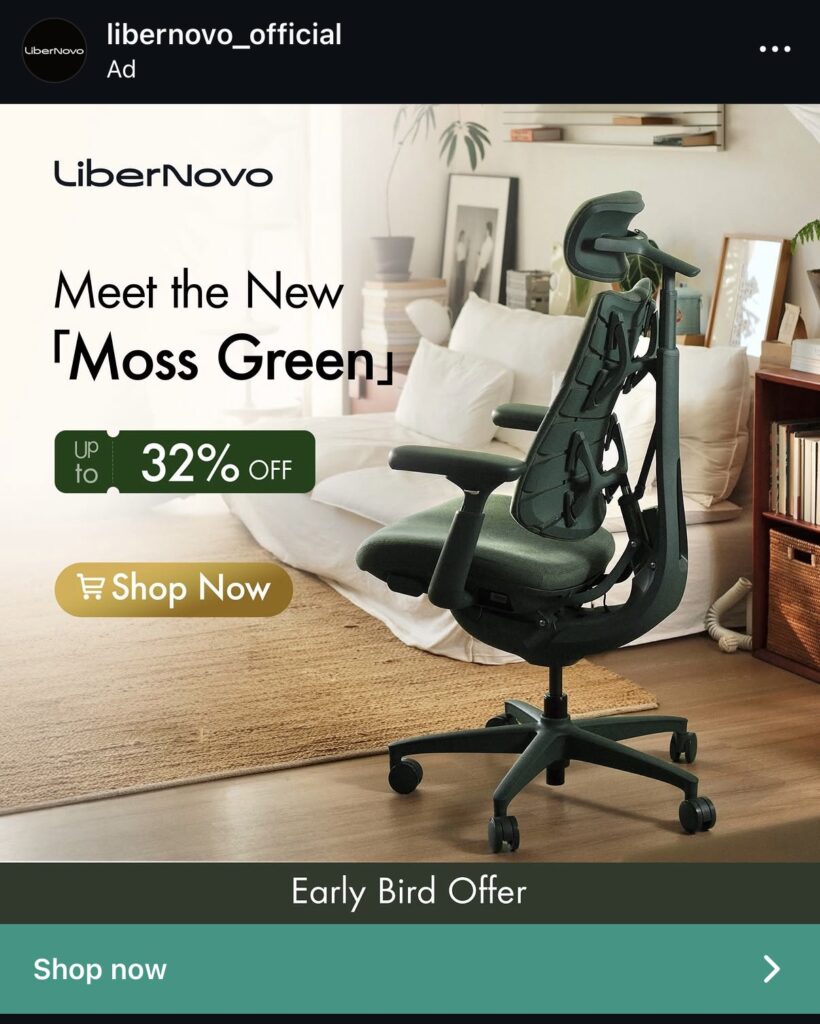
One of the quieter red flags with LiberNovo is how it prices the Omni.
Every time I checked their site during this process, there was some combination of:
- “limited time” discount
- “early bird” pricing
- multiple overlapping discounts and codes
- countdown language hinting that the current price is about to disappear
At some point, that stops feeling like a real sale and starts feeling like those stores that are always going out of business but never actually close.
This matters for two reasons.
First, it plays directly on buyer psychology. If you are a regular person deciding whether to drop close to a thousand dollars on a chair, a perpetual sale makes you feel like you will lose if you wait. That is pressure, not information.
Second, it raises a basic honesty question. If the Omni is always on sale, then that is not a sale price. That is the real price with extra theatrics.
Combine that with:
- Kickstarter backers still waiting on orders
- retail buyers describing missing accessories and delayed shipments
- and a marketing narrative about massive demand and sold out runs
- and a brand new colorway added but at a DISCOUNT with new materials and slight design changes.
and the whole thing starts to feel less like a stable company and more like a pop up.
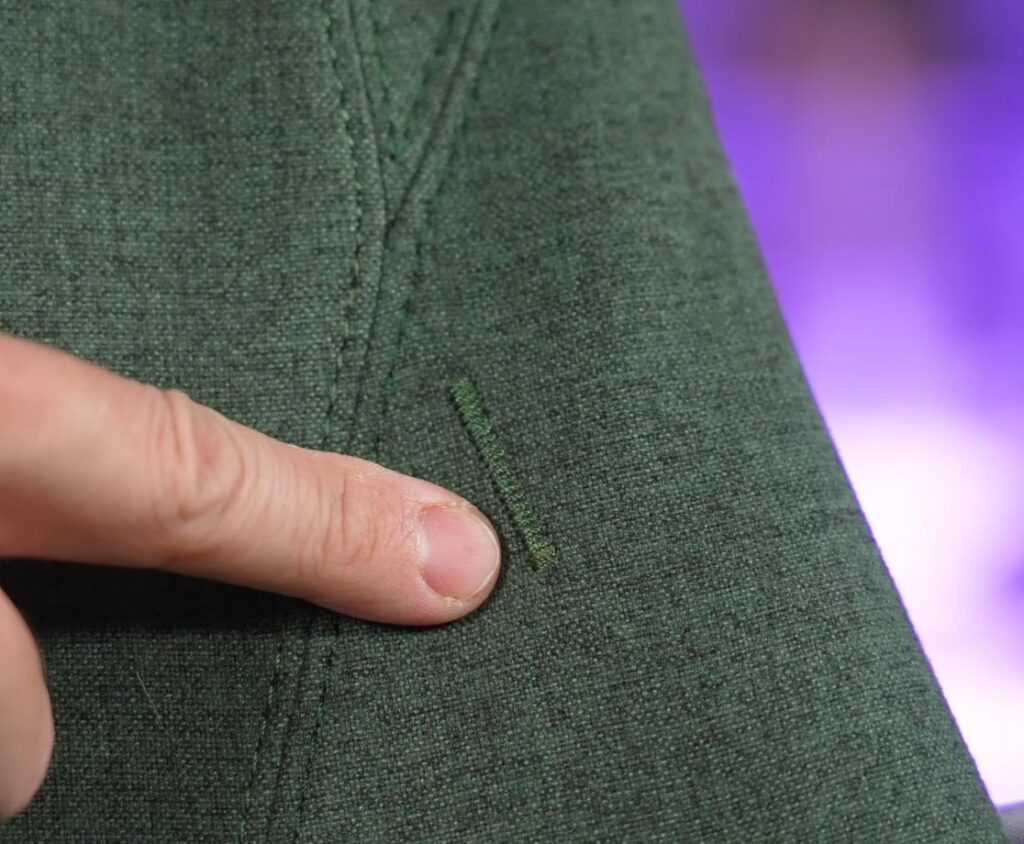
Don’t get me started on the “New” green version where the CLOSING stitches are on the OUTSIDE of the chair. Not hidden. My seamstress grandmother and ladies tailor grandfather are turning in their graves. MY GOD. It’s insane the lack of care or common knowledge.
Part 15: Payment As Leverage, One Last Time
After the Amanda call and the handoff to Eileen, the first fifty percent was promised. The chair arrived. The footrest showed up. I started drafting a video and an article that looked a lot like what you are reading now, minus this postmortem on process.
On paper, everything was now “back on track.” In reality, there was still a quiet tug of war happening around payment and perception.
Everyone on their side knew the second fifty percent could not legally be tied to my opinions. That clause is clear. They signed it.
At the same time, their emails kept circling around my public posts and the “overall sentiment” of the collaboration.
On January 15, 2026, Eileen wrote:
“Just wanted to check in and see how things are going on your end. I thought we had been staying in touch.
Also, are you aware of X’s situation regarding this?”
No specifics. Just a vague wave at “X’s situation.”
Jessica replied, asking what she meant and pointing out that yes, we were literally in contact the day before about payment and scheduling.
The next morning, after Eileen linked one of my old deleted posts on X, Jessica laid out the context very clearly what they already knew:
- Tristan had posted on X and LinkedIn when the signed contract was not being honored.
- That escalation is what led to Amanda stepping in and confirming the contract would be honored.
- Those posts were removed after the call, as agreed.
- The chair had now arrived.
- The only thing “happening” on our side was waiting for the agreed 50 percent advance to be processed so we could begin production.
She replied:
“Hi Jessica,Thank you for your reply and for clarifying — I appreciate it.
To be honest, I was quite saddened to see this, as I genuinely thought our communication had been going smoothly and that we had a pleasant and constructive exchange throughout. On my end, I’m still actively pushing the payment process forward and doing my best to move everything along as planned.
What prompted my message is that I came across a post on X earlier this morning:
https://x.com/tristanpope/status/2008625780394197234Seeing this raised some concerns on our side, and I wanted to better understand what might be happening. Jessica, would you be able to help connect with Tristan and see what’s going on? If this is simply a misunderstanding, I would truly be happy to see it clarified and resolved.
Thank you so much for your help, and I appreciate your time and support.
Warm regards,
Eileen”
Then I wrote directly to Amanda.
In that January 16, 2026 email, I said what a lot of creators are scared to put in writing:
“When payment keeps getting delayed after you’ve confirmed the contract will be honored, it creates uncertainty and prevents my team from scheduling and beginning the review in good faith. Is LiberNovo using payment delays as leverage with creators? Because it certainly feels that way on my end.”
I also pointed out that their internal messages conflicted. One email saying the collaboration was moving forward “positively,” another framing things as “paused” or “under review,” all while the chair was already in my studio and the contract was unchanged.
I asked them to “speak plainly and confirm what is needed to finalize and proceed.”
Two days later, on January 18, 2026, Eileen replied to me directly. Here is the core of that message:
“Hi Tristan,
Thank you for sharing this — and I am genuinely glad to hear that you have already assembled the chair and are enjoying it.
I want to speak plainly and transparently, as I completely understand your frustration.
Nothing is ‘paused’ or wrong on our side in terms of intent or commitment. The payment delay is not being used as leverage in any way. The only reason this has taken longer than expected is due to our internal finance review process. Since we have not yet received any final published content, last week’s payment request went through an additional layer of review, which extended the approval timeline.
To move this forward, I have already provided our finance team with extensive context and supporting materials to demonstrate that our collaboration has been progressing positively and in good faith. The photos and videos you shared have been extremely helpful in reassuring them and accelerating the process.
Our payment approval workflow is unfortunately quite strict, but please know that I am actively pushing this on my end and fully advocating for your project. We truly appreciate your patience, and this week is our top priority to finalize and release the payment.
If there is anything unclear or if you would like to talk through this live, I am always open — communication is important to us, and we want to ensure this collaboration continues smoothly.”
On the surface, that sounds reasonable. Finance is strict. Internal review. Nothing is “paused.”
From my side, it read very differently.
- I had a signed contract that required fifty percent up front.
- “I would truly be happy to see it clarified and resolved.” = remove any social media posts we dislike.
- The chair was already assembled in my studio.
- I had already shared a drive link with early impressions and B roll of me and even my cat enjoying the massage feature.
- And now I was being told those photos and videos were “extremely helpful in reassuring” finance and “accelerating the process.”
So while the email insists that payment is “not being used as leverage,” it also ties payment approval to proof that things are “progressing positively” and that I am, in their words, “enjoying” the product.
There was no explicit “if you say something negative, we will not pay you.” The pressure was softer than that, and in my view more insidious:
- Reframe my perfectly reasonable concern as a “misunderstanding.”
- Emphasize how “constructive” everything has been.
- Point to my own early positive footage as comfort food for their finance team.
- Ask for patience while the money sits on their side of the table.
This is why I hid a frame in the video that spelled out that I was being held ransom and since they were being shady, I would honor the contract, but I would also honor the real wording of an HONEST REVIEW later:
- LiberNovo did not control the script.
- LiberNovo did not get approval rights over the review.
- The contract specifically barred them from withholding payment because they disagreed with my opinions.
They did not like that. They asked if it was really necessary, if we could soften it, if mentioning the contract might “confuse viewers” or “affect how people see the brand.”
I did not move it an inch.
We published.
The second fifty percent did not appear overnight. It arrived after a few more “finance is processing” messages. Eventually, the wire landed.
At that point, they had no more leverage.
No unpaid invoice.
No unshipped product.
No outstanding obligation.
Which is exactly why you are getting the rest of the story now.
This is me honoring the contract in the only way that makes sense: giving the full honest review that was supposed to be safe from the beginning, without any payment or shipment hanging over my head.
Part 16: Why I Am Publishing This Now
So why now. Why not just move on.
Four reasons.
First, honesty should not be a risk. If a brand markets itself as science driven and customer focused, but internally treats honest feedback as a thing to manage away, that is information you deserve before you drop serious money on their product.
Second, this pattern matters beyond one chair. We are all buying into ecosystems now, not just objects. Warranties, electronics, apps, replacement parts. A company that struggles to honor a signed deal with someone who has a platform is not likely to magically be better with a random customer whose only leverage is a support ticket.
Third, the Omni is not the magic ergonomic fix the ads suggest. It is a very soft, very tech heavy chair that might feel nice to some people in short bursts, but long term everyone says the same thing “This hurts me”. It is also, in my testing and in detailed reviews like that Amazon post, a chair with basic ergonomic issues that no amount of massage and marketing language covers up and might end up with long term pain/fatigue.
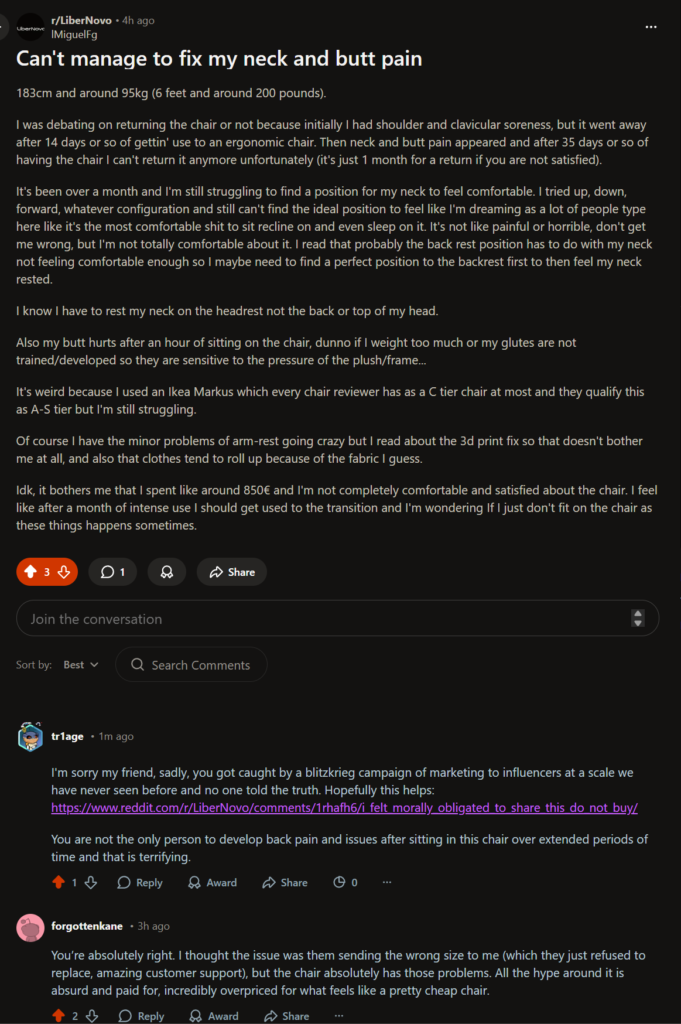
And lastly, this took a real toll. I was losing sleep, not knowing if they were going to throw another curveball at 3AM, and it felt manipulative. What should have been a straightforward chair review turned into a deep dive on the company to protect myself and reputation(Remember as I said earlier, this is my JOB), and the more I found, the harder it became to even know how to proceed without revealing what I found.
LiberNovo has paid. I have fulfilled the contracted deliverables. They no longer have any hold on what I say.(they never did according to the “contract” that they were happy to ignore.)
This is what I would have said on day one if honesty had actually been safe inside the deal.
Part 17: So… Should You Buy The LiberNovo Omni?
Here is my personal, fully paid, contract honoring opinion: NO!
As a chair:
- Even though it may seem comfortable in the short term, especially if you like very soft seats, it has some real ergonomic problems, such as non locking armrests, a shorter than advertised seatpan depth (when actually measured less than 40cm), limited and poorly chosen fixed recline positions, bad materials for longevity, and a cushion that bottoms within minutes.
- It does not, in my experience, deliver the long haul pressure relief and spinal support story that its science pages and borrowed visuals imply. If anything the massage spinal mechanics might hurt you if used as “support” when not laying back but sitting down. This is not “lumbar support” and it isn’t “Dynamic”.
- People are starting to, after having time with the chair expressing a common issue of back pain STARTING after extended use of this chair. This is the most important issue you need to be aware of!
As a product in a support ecosystem:
- You are buying from a very young brand, that no one knows who is pulling their strings, with no visible engineers or owners, buying as much clout as possible, so their reputation is hard to know for sure.
- Public reviews show a mix of happy customers(purchased like their reviews?) and deeply frustrated buyers who did not get what they ordered or who struggled with returns and refunds or ANY customer support.
- My own experience as a partner shows a company that struggled to honor a signed agreement until public pressure and shady tactics I have not seen since my early years on YouTube dealing with the wild west of Vape Companies releasing versions every week of their products.
Because of all that, my recommendation today is simple.
If you are a consumer, I would not buy this chair right now.
Not until LiberNovo proves, publicly and consistently, that:
- they can deliver orders and accessories on time
- they can respond to support issues promptly and transparently
- they can handle mixed or critical coverage without treating honesty as a risk that needs to be controlled
- They redesign the chair to actually fulfill their ergonomic claims they “borrowed” from companies like Anthros.
- They are more than a marketing firm that outsourced a popup shop of “engineers”.
If they do that over time, great. I will happily update this story.
Right now, my advice is to keep your money in your wallet or spend it with brands that already have a track record of doing those things.
Part 18: Two Stories, One Wallet
There are two narratives running in parallel here.
The first is the one LiberNovo wants you to see:
- the biggest ergonomic chair Kickstarter
- the dynamic spine visuals and pressure maps
- the influencer wall of “best chair ever” thumbnails
- the constant feeling that you need to buy now before the deal vanishes
The second is the one real people are telling:
- customers waiting months for chairs or accessories
- customers fighting for refunds
- detailed reviews describing the ergonomics versus comfort paradox
- creators getting classified as “risks” for insisting on the same honesty those marketing decks pretend to celebrate
- creators getting eye watering amounts of money to speak “honestly” about this chair.
- Creators getting eye watering affiliate kickbacks above industry standards to CONTINUE to speak “HONESTLY” about this chair.
Your wallet decides which story wins.
Part 19: When “Honesty” Comes With a Commission Code
We need to talk about the money.
Not in a vague “yeah, sponsorships exist” way, but in a very specific “this is how the narrative gets shaped” way.
LiberNovo did not just send out a few chairs and hope for the best. They spent real money. Eye watering money.
- Large flat fees for creators to speak “honestly” about the chair.
- Commission structures that, in my experience of this industry, sit on the very high end of what brands usually offer.
- Extra affiliate bonuses and stacked incentives to keep that “honesty” flowing long after the launch window.
On paper, none of that is illegal or even unusual. Sponsorships and affiliate links are how a lot of channels survive. I do sponsored work. I use affiliate links. I am not pretending to be above it.
The problem is what happens when you combine:
- a product with serious open questions around ergonomics and long term comfort
- a company with serious open questions around service, fulfillment, and transparency
- and a marketing budget big enough to carpet bomb YouTube and social feeds with “this is my new favorite chair” thumbnails
Money does not force anyone to lie. But it absolutely shapes what gets said, what gets left out, and what gets turned into “drama content.”
We have already seen that play out around this chair:
- Creators paid very well to speak “honestly” about the Omni during the launch wave.
- Creators offered generous affiliate rates to keep that message going indefinitely.
- Creators making videos about disclosure drama, FTC wording, and “sponsored vs unsponsored,” while still propping up the same chair and the same company with links in the description.
Instead of asking “is this chair actually solving long term ergonomic problems?” or “why are so many buyers stuck in support purgatory?”,
and most importantly “Why are so many people saying long term use of the chair is actually hurting their posture/body?”
the discourse drifts to:
- who got paid
- who disclosed properly
- which affiliate code you should use
In other words, the emotional energy gets pointed sideways, creator versus creator, while the brand sits on a mountain of Kickstarter money and FREE exposure.
To be crystal clear:
I am not accusing any specific creator of lying in their review. I am saying the incentives are built so that:
- glowing first impressions get amplified
- nuanced, mixed, or negative follow ups quietly die
- and the people with the least leverage are the ones who actually paid full price
When you see a wall of “this is the best chair ever” videos for the same product in the same few months:
- ask yourself how many of those creators were offered above normal compensation to be part of that wave
- ask how many have posted a follow up after six months of real use
- ask how many still use the chair when there is no sponsored deliverable attached
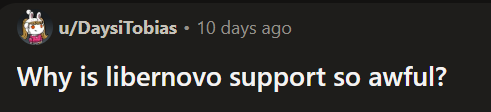
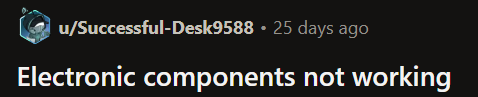
And then compare that to the people on Reddit, Amazon, and Trustpilot writing multi paragraph breakdowns of back pain, return fights, and unanswered tickets for free.
Seriously, go look:










That is why I keep coming back to the same line:
Companies work for you.
You do not work for companies.
That includes creators, too. We either stand with you and take the hit when honesty is inconvenient, or we quietly let the money talk louder than the long term truth.
Your wallet decides which version of “honesty” survives.
The Grande Finale: This Is The David Versus Goliath Part
LiberNovo sits on millions in crowdfunded revenue and a global ad budget.
I am one guy in a studio with a camera and a spine that does not enjoy being lied to.
But this is not really about me versus them. It is about all of us lining up on one side of a very simple question.
Do we reward companies that use contracts as optics and marketing as a shield, or do we reward companies that honor agreements, fix problems, and stay transparent when the truth hurts?
You and your friends are thousands of people with wallets.
Every time you choose not to reward this pattern of behavior, you make it more expensive for companies to rely on marketing and pressure tactics instead of solid products and solid support.
Every time you support brands that honor contracts, fix issues, and tell the truth even when it costs them, you push the market a little closer to something healthy.
This is how David wins. Not by throwing one perfect stone, but by getting a whole lot of people to stop feeding Goliath.
If a brand cannot handle the honest review it paid for, think very carefully about how it will handle your warranty claim when there is no camera on, no social media support, no “subscriber” pressure.
I wish this had been a straightforward review of a cool new ergonomic chair.
Instead, it turned into a case study in what happens when marketing outruns infrastructure, when science becomes costume jewelry, and when a company discovers that “honesty” sounds great until it has a price tag.
I have been paid. I have tested the product. I have honored the contract.

Now I am honoring you.
Want a good chair? One that will not hurt you the longer you sit?
I’ve never felt bad about someone making a purchase from an affiliate link before(required by contract that I HONOR, unlike them…)
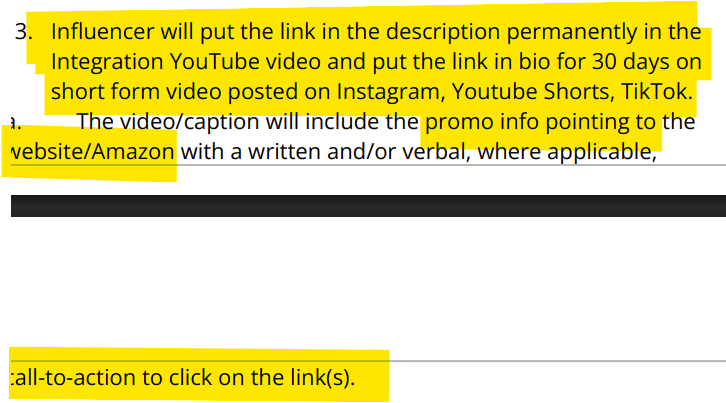
After all it helps me stay afloat, but when I saw the first two sales from my video on the Libernovo, I knew you all needed better.
Two chairs I can 100% get behind and support, watch the videos below:
Anthros:
Crandall Offices Refurbished Leap V2: